

binary code
 3
3.5
3
3.5

- noun
- /ˈbaɪnəri koʊd/
- Specialized
- Try using binary codes to reduce the data table in the charts.
- the computer uses binary code
Examples
-
Compiling translates a C program into binary code and saves it as an executable file that runs on a specific processor.
Academic text (2009) -
The original binary code is shown in Figure 1.
Blog text (32) -
In order to fully understand the message encoded in the transmission, it's essential to understand the binary code.
Blog text (32) -
The binary code for the size of the transmitter is also altered.
Blog text (32) -
The message within the disk was deciphered using the standard 8-bit binary code known as ASCII (American Standard Code for Information Interchange).
Blog text (32) -
Text messages are converted into binary code, using patterns of 0s and 1s to represent each character.
-
When you save a document on your computer, it's stored as binary code made up of combinations of zeros and ones.
-
Programming languages are ultimately compiled into binary code, which computers can read and execute.
Synonyms
 1
4.9
1
4.9
A set of instructions in numbers that a computer's processor can run directly
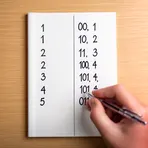
A way to write numbers and information using only the digits 0 and 1
Surface Forms
Morphology
The meaning is directly and compositionally derivable from 'binary' (relating to a 0/1 numeral system) and 'code' (instructions or encoded data), so a learner who knows both words can infer it refers to code expressed in 0s and 1s. This is a technical, literal compound with a clear cross-linguistic and STEM-consistent logic, making it readily comprehensible to B1 learners familiar with the constituent terms.
Etymology
Binary code comes from the simple idea that binary means two choices, like a light switch that is 'on' or 'off', and code means a set of signs, so patterns of 0s and 1s can stand for letters or instructions. That's why binary code means the way computers use 0s and 1s to store text and commands.