

bicameral
 3
8.6
3
8.6

- adjective
- /baɪˈkæmərəl/
- The law charged the 12-member bicameral committee with finding $1.5 trillion in deficit reduction over ten years.
- bicameral legislature
- bicameral committee
Examples
-
The United States is a democracy with a bicameral legislature, consisting of the House of Representatives and the Senate.
-
The United States is a democracy with a bicameral legislature and separation of powers.
Blog text (8) -
The plan called for a bicameral regional legislature.
Academic text (1990) -
Local government became effectively bicameral.
Academic text (1993) -
In principle, it is a choice between a unicameral and bicameral parliament.
Blog text (23) -
The bicameral Russian Supreme Soviet was a thoroughly new variable in the Russian foreign policymaking process.
Academic text (1998) -
Likewise, a bicameral legislature in a federal parliamentary system, such as Germany, may incentivize executive oversight.
Academic text (2016) -
Unlike the United States, Zambia lacks the checks inherent in a federal state with a bicameral legislature.
Academic text (1994) -
However, we find that bicameral legislatures do not develop stronger committees than unicameral legislatures.
Academic text (2016) -
Delaware's delegates supported the Great Compromise, which created our bicameral system with the House based on equality of population and the Senate based on the equality of states.
Academic text (2016)
Synonyms

Having two separate chambers, as in some hearts or machines
Antonyms
Compounds
 1
6.6
1
6.6
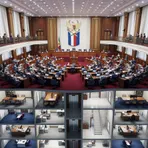
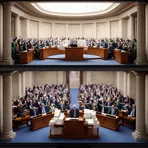
A body that makes laws with two separate houses, for example a Senate and a lower house

How Many Chambers
3
8.6
 1
8.1
1
8.1
Surface Forms
Morphology
bicameral = cameral (semi-transparent) = bi + cameral
The prefix 'bi-' (two) is transparent, but the adjective 'cameral' is rare in modern English and learners may not recognise it or connect it with 'chamber', so the formation is only partly obvious.
Etymology
Bicameral comes from bi- meaning 'two' and the same root as chamber meaning 'room' or 'house'. So bicameral literally means 'two rooms' and is used for bodies such as parliaments that have 'two houses' or two main parts.