
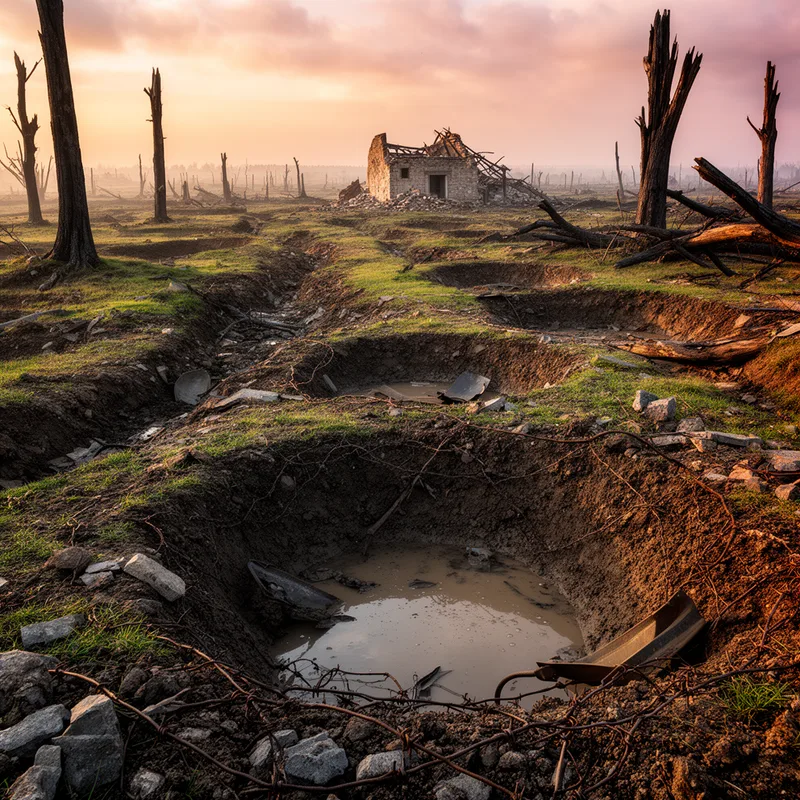
battle-scarred landscape
- noun
- The battle-scarred landscape stretched for miles, with craters and broken trees as far as the eye could see.
Examples
-
After years of fighting, villages were restored but the battle-scarred landscape still bore the wounds of war.
-
Historians visited the battle-scarred landscape to study the effects of the decades-long conflict.
-
The battle-scarred landscape told a story of resilience.
-
After the war, the battle-scarred landscape was a haunting reminder.
-
After years of fighting, the battle-scarred landscape still bore the visible marks of conflict.
-
The battle-scarred landscape was a stark reminder of the devastation caused by the war.
-
Walking through the battle-scarred landscape, they could see the remnants of destroyed buildings and scorched earth.
Synonyms
 228
3.2
228
3.2

An area where soldiers fight during a war
 1
6.5
1
6.5
A wide area that is badly damaged, often by war or natural disaster
Antonyms

How Damaged
 15
1.2
15
1.2
Surface Forms
Morphology
battle-scarred + landscape
The meaning is directly compositional: 'battle-scarred' = scarred or marked by battle and 'landscape' = an area of land, so a learner who knows 'battle' and 'scarred' can infer it denotes land visibly damaged by war. This adjective+noun pattern is a regular, cross-linguistic construction and follows normal English compounding, making the expression immediately understandable to a B1 learner.
Etymology
Battle-scarred landscape uses the image of a wounded body: a battle leaves the landscape scarred with craters, broken trees, and damaged buildings, so it means 'an area marked or damaged by war'.