
barley water
- noun
- /ˈbɑrli ˈwɔtər/
- Today, those old-time barley waters have all been superseded by zippier potations.
Examples
-
Another variant of barley water in France, called orgemonde, was flavored with ground almonds.
Academic text (1994) -
- May I have some barley water?
-
At a friend's suggestion, I also started drinking barley water several times a day.
Blog text (17) -
There is no longer any barley water tradition in the English-speaking world, but there once was, and as C. Anne Wilson explains in Food and Drink in Britain (Barnes and Noble, 1974), this heritage exemplifies the history of the drink all over early modern Europe:
Academic text (1994) -
In Spain itself, the most venerable of all grain drinks, barley tea, or barley water, survives only as the name of a popular beverage called horchata.
Academic text (1994) -
In spite of this morning's shocking disturbances, You may be sure that Britannia will continue to serve and to succour Unfortunately, the kitchens are temporarily out of order, but during the next hour there will be a service of soft drinks: with the choice of orange and lemon barley water.
-
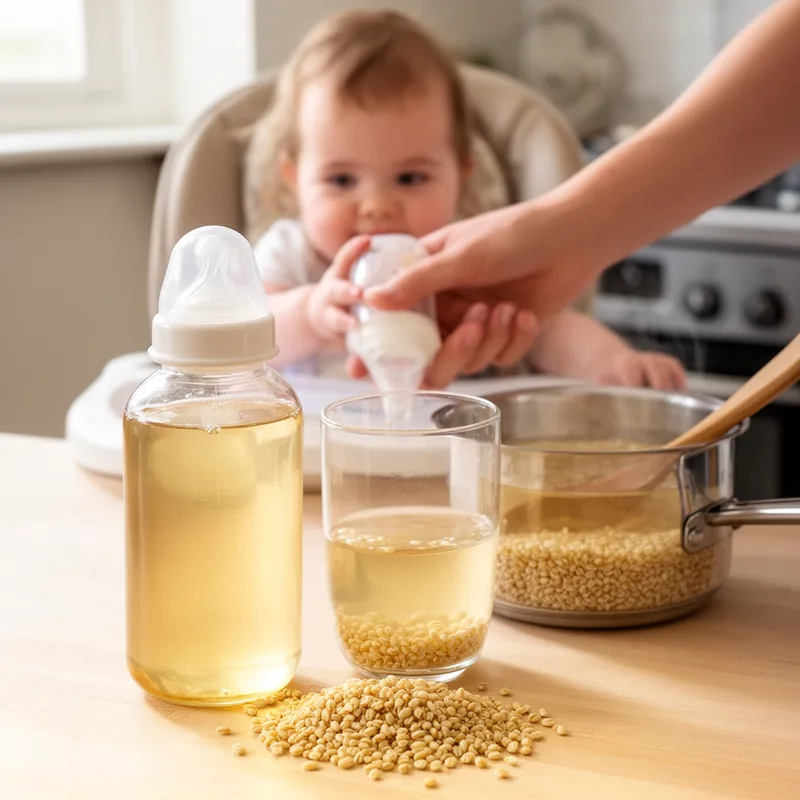
Many parents choose to give their babies barley water as a soothing drink.
-
After a long day in the sun, I enjoyed a refreshing glass of barley water.
-
The doctor suggested that she drink barley water to help with her recovery.
How Nourishing


Surface Forms
Morphology
The meaning is directly compositional: 'barley' (the grain) + 'water' (drinkable liquid) yields a water-based beverage made with barley. This noun+noun construction parallels many transparent drink names (e.g., 'lemon water') and would be correctly understood by a B1 learner who knows both constituents.
Etymology
Barley water comes from a simple kitchen drink: people boil barley, a common grain, in water and then strain the liquid to make a mild, slightly sweet 'drink'. Because this liquid was easy to digest and often given to babies or sick people, barley water came to mean 'a gentle, nourishing drink'.