
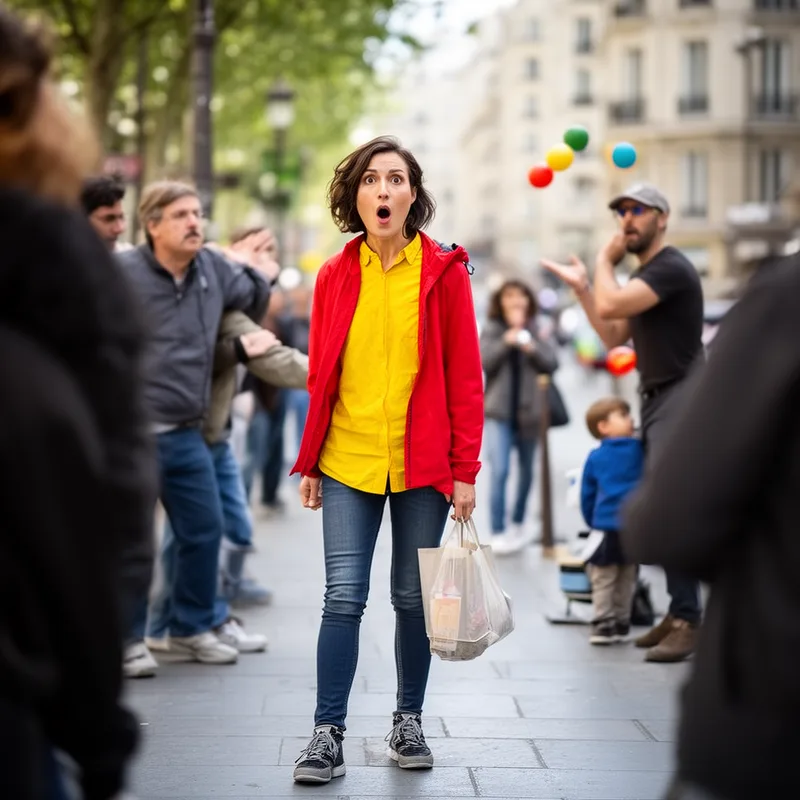
badaud
- noun
- Offensive
- As a badaud, she often found herself stopping to watch parades and celebrations, curious about everything happening around her.
- flâneur and badauds
Examples
-
Fournel's text shows how the flâneur and the badaud emerged alongside each other as related but contrasting consumers of the urban scene.
Academic text (2015) -
Although we may admire the elegantly expressed curiosity of the flâneur, we more easily (if not willingly) identify with the diversions of the badaud.
Academic text (2015) -
The matter of the badaud's emotional engagement, though, is more complex.
Academic text (2015) -
Thus, the badaud exemplifies the condition Schapiro described as the self being "wholly dissolved by the world."
Academic text (2005) -
Once again we mirror the badaud, and the crowd's mix of social classes tells us that anyone is susceptible to gawking's appeal.
Academic text (2015) -
The composition also places the viewer, and therefore the artist, in a similar position to the badaud at lower right, straining to look over a mass of heads and top hats in order to see.
Academic text (2015) -
Yet, while the flâneur is one of the most studied and referenced subjects of nineteenth-century culture, the badaud remains remarkably obscure.
Academic text (2015) -
In contrast to the cool detachment and intellectual control of the flâneur, badauds are emotional, highly impressionable, and distractible.
Academic text (2015) -
As Fournel explained in 1858, "The simple flâneur is always in full possession of his individuality, whereas the individuality of the badaud disappears."
Academic text (2005) -
The crowd of badauds gathered around the street performer, captivated by his tricks.
Synonyms

 123
2.6
123
2.6

A person who watches an event or show without taking part
 24
3.2
24
3.2
A person who watches something without taking part
 3
9.9
3
9.9
A person who watches something without taking part
 1
8.6
1
8.6
A person who stares for too long at accidents or unusual events
 1
8.8
1
8.8
A person who stares at accidents or strange events

A person who watches an event without taking part
Antonyms


How Curious

Surface Forms
Etymology
Badaud comes from French and the old verb bâder, meaning 'to gape'. Think of a group that stops to stare—like a gawker—and you have a badaud, someone who watches out of idle curiosity.