
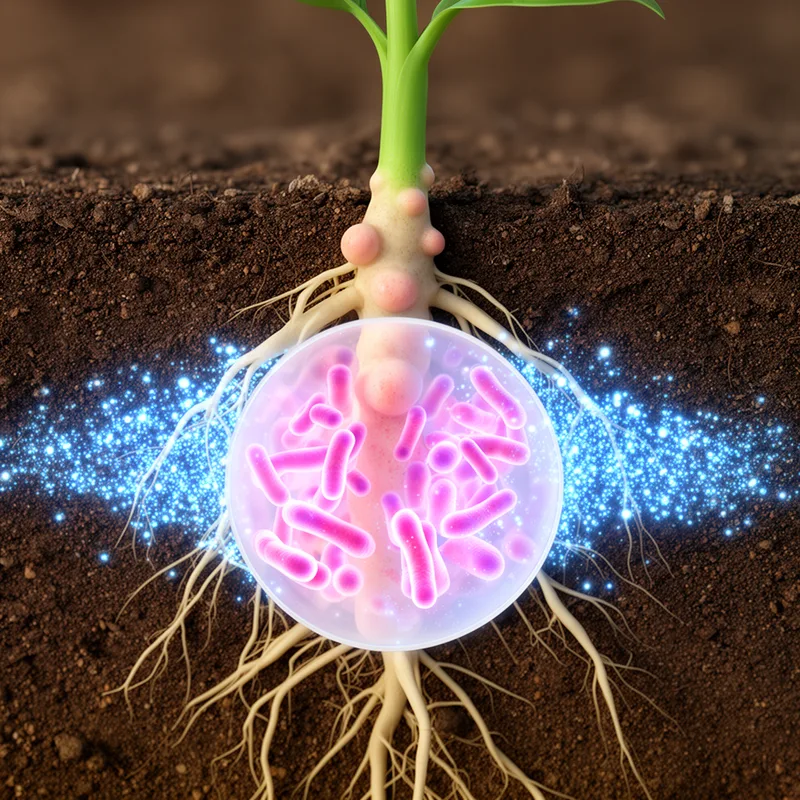
bacteroid
- noun
- /ˈbæk.tə.rɔɪd/
- Specialized
- Many bacteroids are found in the root nodules of legumes.
Examples
-
The presence of bacteroids in the root nodules enhances nitrogen fixation in legumes.
-
The presence of bacteroids in the root nodules enhances nitrogen fixation in legumes.
-
Scientists observed the transformation of bacteria into bacteroids during symbiosis with the host plant.
-
The microscopy slides clearly showed numerous bacteroids within the plant cells.
-
The bacteroid plays a crucial role in nitrogen fixation.
-
The microscopy slides clearly showed numerous bacteroids within the plant cells.
-
Many bacteroids are found in the root nodules of legumes.
Synonyms



 1
9.9
1
9.9
A type of bacteria that lives on roots of bean and pea plants and adds nitrogen to the soil
Surface Forms
Morphology
bacteroid = bacterium (transparent) = bacter + oid
The noun sense names an organism 'resembling a bacterium' and is formed by adding the productive '-oid' to the bacterial base, so the relation is directly derivable.
Etymology
The word bacteroid comes from the root bacter- ('small rod' or 'microbe') and the ending -oid ('like'), so it means 'something like a bacterium'. In biology, a bacteroid is a rod-shaped or bacteria-like cell, often the form found inside plant root nodules that helps the plant take nitrogen from the air.