
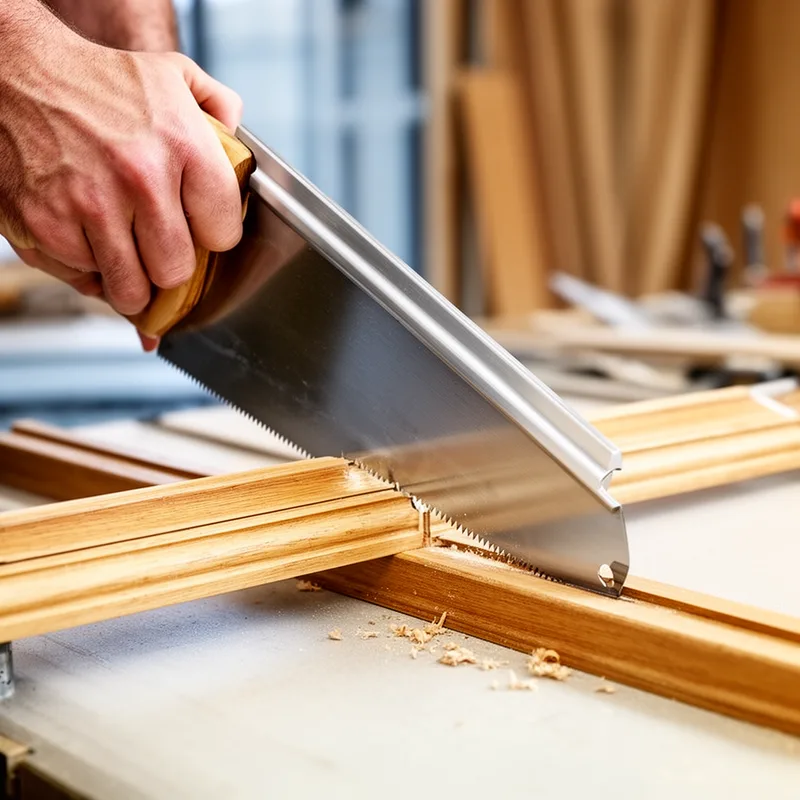
back saw
- noun
- /bæk sɔ/
- Specialized
- He used a back saw to carefully trim the molding for a perfect fit.
Examples
-
The carpenter recommended a back saw because of its sturdy reinforced spine.
-
A back saw is ideal for making precise cuts in woodworking projects.
-
He picked up the back saw to finish the project.
-
The carpenter uses a back saw for detailed cuts.
-
A back saw is ideal for making precise cuts in woodworking projects.
-
He used a back saw to carefully trim the molding for a perfect fit.
-
The carpenter recommended a back saw because of its sturdy reinforced spine.
Synonyms

 54
1.0
54
1.0

A tool with a thin toothed blade used to cut wood or other materials
 1
2.1
1
2.1
A saw used with one hand to cut wood

A short hand saw that has a stiff metal back for making precise cuts in wood
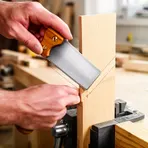
A small saw with a stiff back and fine teeth for cutting small angled joints in wood
Surface Forms
Morphology
This is a straightforward compound in which 'back' describes a part of the tool and 'saw' names the tool, so a learner who knows both words can reasonably infer it is a saw with a reinforced/rear (upper) edge used for precise cutting. The meaning is compositional and descriptive rather than idiomatic, a common naming pattern, so it is immediately understandable to B1 learners familiar with the constituents.
Etymology
The noun back saw is named for the stiff upper edge, the back, on its thin blade that keeps the saw straight. That 'back' makes the blade steady, so carpenters use it for 'precise' cuts when working with wood.