
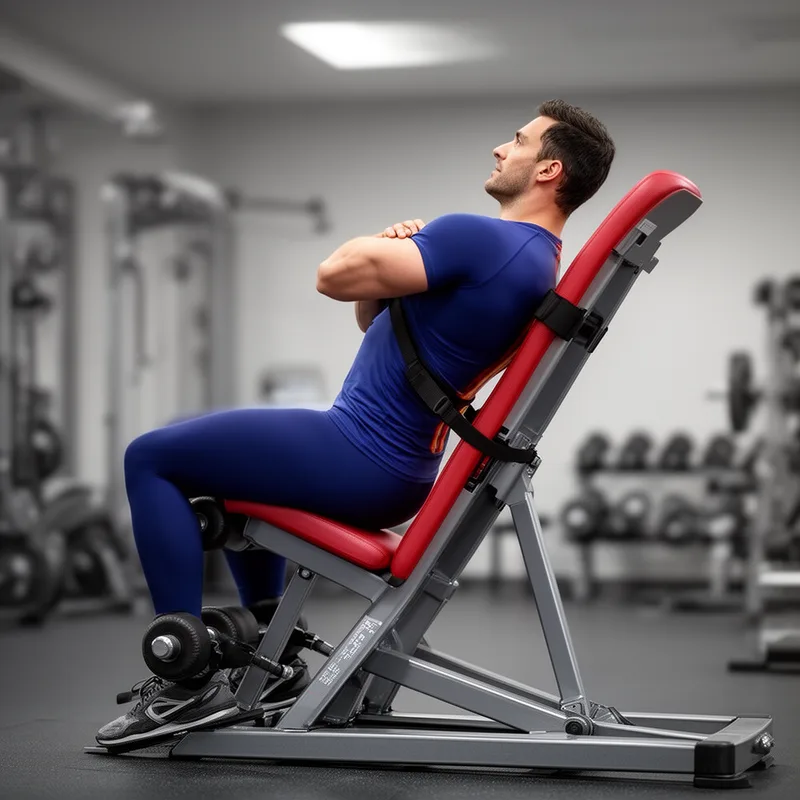
back extension
- noun
- /bæk ɪkˈstɛnʃən/
- Pain is present on palpation over the articulations, with decreased range of motion and increased pain with low back extension and joint compression.
- isoinertial back extension
- Cybex back extension
Examples
-
To strengthen her lower back, she regularly includes back extension exercises in her workout routine.
-
GIRL 1: I'm sore from the back extensions.
-
Isoinertial Cybex back extension exercise equipment.
Academic text (1997) -
Strength testing is conducted on a back extension machine (Cybex) in the sitting position.
Academic text (1997) -
Trunk strengthening is performed on isoinertial back extension and rotation equipment and on a Roman chair (Parabody, Ramsey, MN).
Academic text (1997) -
As a relatively inexpensive method of strength testing, we have developed techniques for using a simple isoinertial back extension unit (Cybex, Lumex Corp., Ronkonkoma, NY) found in most fitness facilities (Figure 2).
Academic text (1997) -
The instructor demonstrated the back extension on a stability ball to improve spinal health.
-
Performing a back extension can help alleviate pain by strengthening the lower back muscles.
Synonyms



 1
2.6
1
2.6
A move that makes the muscles in your back stronger
Surface Forms
Morphology
The meaning 'an exercise that extends or bends the back' is directly and compositionally derivable from 'back' (the body part) + 'extension' (the action of extending or stretching). This noun–noun combination is a transparent descriptive label used in exercise contexts and aligns with common cross-linguistic patterns, so a B1 learner who knows the constituents should infer the meaning.
Etymology
Back extension comes from the simple image of the body: the back is moved into an extension, a backward stretch. So the phrase means 'an exercise that bends your back backward to strengthen the lower back and improve posture'.