
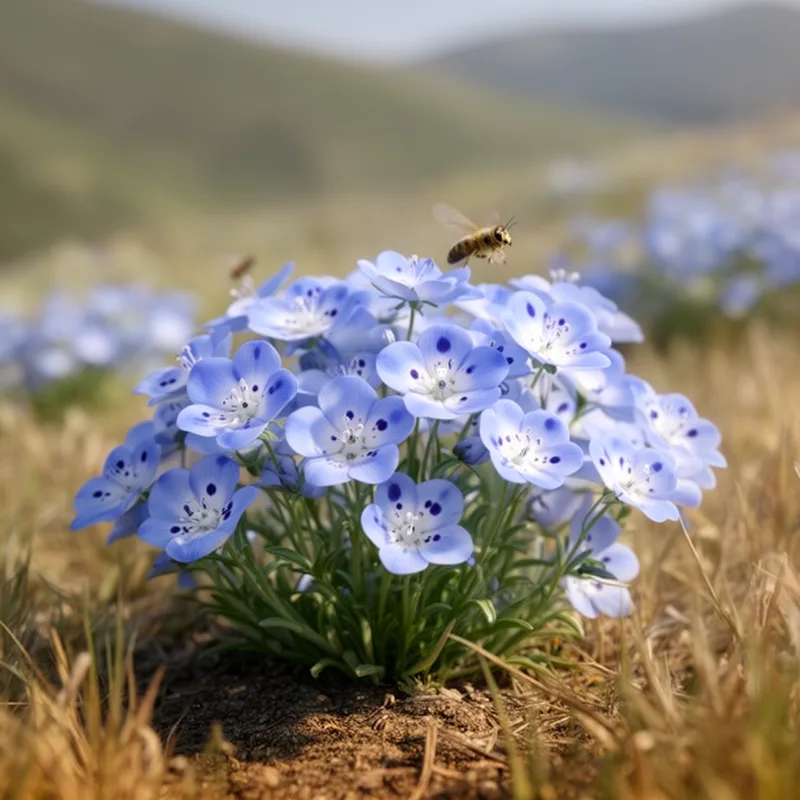
baby blue-eyes
- noun
- /ˈbeɪbi ˈbluː aɪz/
- US
- We spotted patches of baby blue-eyes growing along the hiking trail, brightening the landscape.
Examples
-
The baby blue-eyes bloomed in abundance across the Californian hillside in the spring.
-
I planted some baby blue-eyes in my garden.
-
Gardeners often choose baby blue-eyes for their soft blue color and ability to attract pollinators.
-
The baby blue-eyes bloom beautifully in spring.
-
Gardeners often choose baby blue-eyes for their soft blue color and ability to attract pollinators.
-
The baby blue-eyes bloomed in abundance across the Californian hillside in the spring.
-
We spotted patches of baby blue-eyes growing along the hiking trail, brightening the landscape.
Synonyms

A small California plant with blue flowers that have dark spots

A small plant with bright blue flowers often grown in gardens
Surface Forms
Morphology
baby + blue-eyes
The phrase is clearly descriptive: 'baby' suggests small or delicate and 'blue-eyes' describes blue, eye-like markings, so a learner who knows the parts can infer something small with blue, eye‑like features. However, nothing in the constituents uniquely indicates that the referent is a specific flowering plant rather than a person, animal, or object, so the denotation as a particular annual flower is not fully predictable from the parts alone.
Etymology
Baby blue-eyes comes from the tiny, round blue flowers that look like a baby's little eyes, often with a dark dot in the center like a pupil. So the name points to a delicate plant known for its 'small blue flowers'.

