
azeotrope


 1
9.9
- noun
- /ˈeɪziəˌtroʊp/
- Specialized
- In some cases, a pair of fluids may be called near-azeotropes if the maximum temperature glide for the pair is very small, even though they may not form an azeotrope.
Examples
-
In some cases, a pair of fluids may be called near-azeotropes if the maximum temperature glide for the pair is very small, even though they may not form an azeotrope.
Academic text (1998) -
Refrigerant mixtures fall into two major groups: zeotropes and azeotropes.
Academic text (1998) -
This is an incredibly complex azeotrope.
-
However, the higher pressure and the fact that the fluid is almost an azeotrope provide an opportunity to design more compact systems with greater efficiency.
Academic text (1998) -
Water forms an azeotrope with many other solvents.
Blog text (34) -
However, azeotropes and near-azeotropes that match the vapor-pressure characteristics of the CFCs or HCFCs they replace are nonexistent.
Academic text (1998) -
However, azeotropes and near-azeotropes that match the vapor-pressure characteristics of the CFCs or HCFCs they replace are nonexistent.
Academic text (1998) -
The temperature alteration during phase change is commonly called "temperature glide." An intermediate class of mixtures, dubbed "near-azeotropes," are really zeotropes that are close to an azeotropic composition and have a very small temperature glide.
Academic text (1998) -
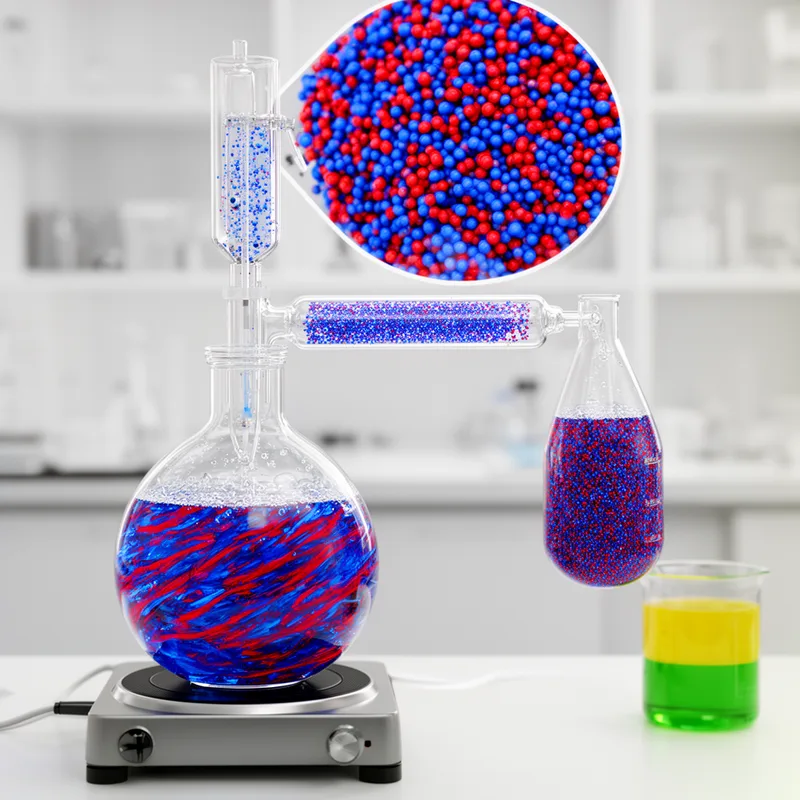
In distillation, an azeotrope cannot be separated into its individual components.
-
When distilling liquids, it is important to identify an azeotrope, as it behaves differently than regular mixtures.
Surface Forms
Etymology
Azeotrope comes from Greek parts a- 'not', zeō 'to boil', and -trope 'turn', and the -trope part is like in tropic meaning 'turn'. So an azeotrope is a mix of liquids that 'does not change when boiled', which is why it cannot be separated by simple distillation.