
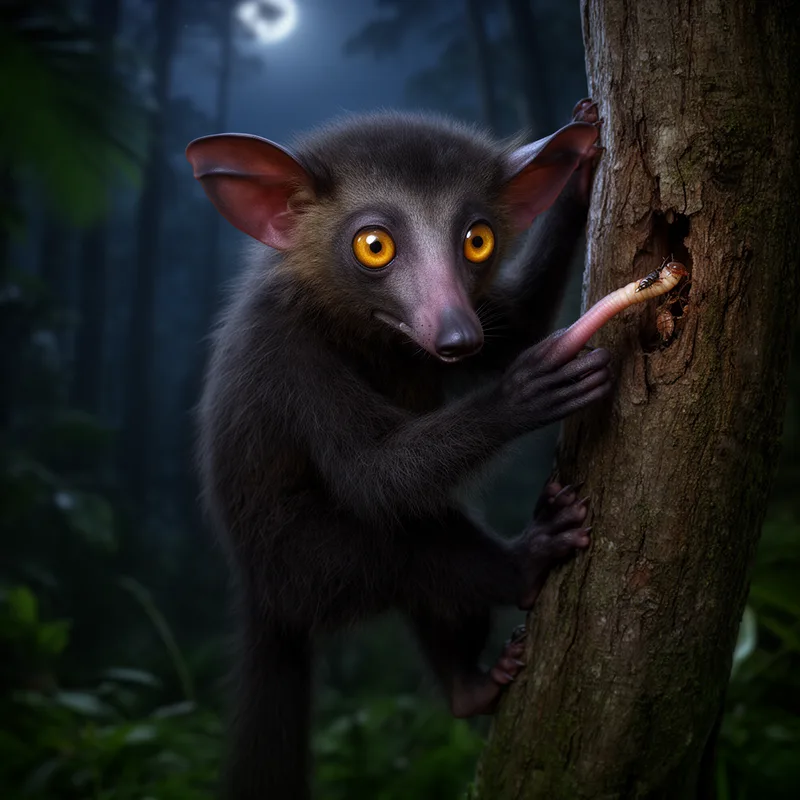
aye-aye


 1
9.9
- noun
- /ˈaɪˌaɪ/
- The aye-aye is known for its unique long fingers, which it uses to extract insects from tree bark.
- see an aye-aye
Examples
-
Three other aye-ayes brought to the zoos died in captivity.
Academic text (1993) -
Two male aye-ayes have been born at the Duke Primate Center.
Academic text (1993) -
One time, an aye-aye called to a second in a nearby tree, and both moved together to a third tree.
Academic text (1993) -
Another time, Sterling saw four aye-ayes together.
Academic text (1993) -
Sterling also saw several aye-ayes in the same or nearby trees calling to one another.
Academic text (1993) -
To see an aye-aye is considered a harbinger of death by many Malagasy.
Academic text (1993) -
"The aye-ayes found the mealworms even when they could not see or smell them," Erickson says.
Academic text (1993) -
Beyond captive breeding, scientists are seeking to learn more about aye-aye biology, behavior, and evolution.
Academic text (1993) -
To increase its numbers, a collaborative captive breeding program for aye-ayes has been launched at zoos and research facilities in four countries.
Academic text (1993) -
Jolly and other scientists have begun studying the elusive aye-aye, seeking to answer questions previously addressed with conjecture, and conservationists have undertaken efforts to protect the creature and its Madagascar habitat.
Academic text (1993)
Synonyms

A lemur from Madagascar active at night with a long thin middle finger to find insects in tree bark
Surface Forms
Etymology
The word aye-aye comes from the local Malagasy name for the animal in Madagascar, where people repeat aye like a call, similar to 'bye-bye'. A helpful way to remember it is that English kept the animal's own name, so aye-aye refers to that strange lemur that lives at night and uses very long fingers.