
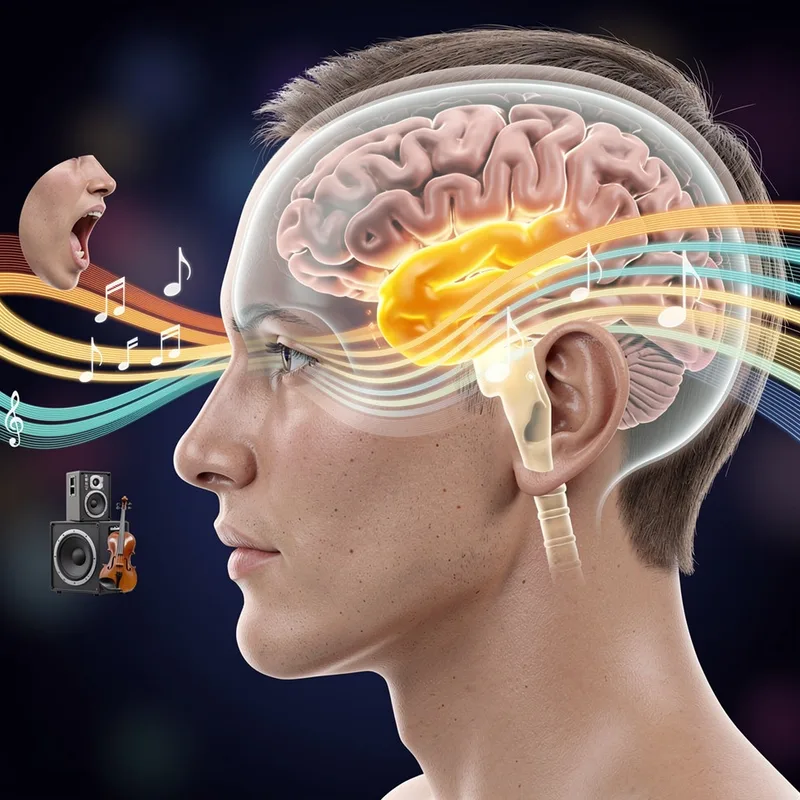
auditory cortex
 1
6.0
1
6.0

- noun
- /ˈɔːdɪtɔːri ˈkɔːrteks/
- Specialized
- The auditory cortex processes sounds, allowing us to enjoy music and recognize speech.
- the primary auditory cortex
Loading YouTube…
Watch on YouTubeSo you don't see with your eyes, you see with your occipital lobe, you don't hear with your ears, you hear with your auditory cortex.
- So you don't see with your eyes, you see with your occipital lobe, you don't hear with your ears, you hear with your auditory cortex.
Examples
-
Animal studies have shown that learning can increase the area of the auditory cortex that responds to behaviorally important sounds.
Academic text (2000) -
For example, a portion of the right auditory cortex has been implicated in the retention of rhythmic patterns.
Academic text (2000) -
This is the primary auditory cortex here.
-
"It's a possible distress signal from the amygdala to the auditory cortex."
Blog text (15) -
Auditory processing occurs in the primary auditory cortex: primary and secondary areas.
Academic text (2015) -
Brain imaging data demonstrate that the primary auditory cortex in the left hemisphere of musically trained subjects is larger than that of untrained subjects.
Academic text (2000) -
So if you have damage to your left auditory cortex, so you have a stroke there or a tumor there, you don't, you don't become deaf.
-
The primary auditory cortex is an area located in the temporal lobe, also known as Heschel's gyrus or Broadmann's area (BA) 41 and 42.
Academic text (2015) -
Researchers discovered that the auditory cortex plays a crucial role in how we interpret different pitches.
-
Damage to the auditory cortex can lead to difficulties in understanding spoken language.
Synonyms
The part of the brain that receives and processes sound

The part of the brain at the side of the head that processes sounds from the ear
How Complex
- Specialized
8
6.4

- Specialized
- Specialized
1
6.0
Surface Forms
Morphology
The meaning is directly and compositionally derived from 'auditory' (related to hearing) + 'cortex' (the brain's outer layer), yielding 'the part of the brain that processes sound'. This adjective+noun technical term follows regular composition patterns and has clear equivalents in many languages, so a B1 learner who knows both constituents should understand it.
Etymology
Auditory cortex comes from the words auditory and cortex, where auditory means 'hearing' and cortex means the brain's 'outer part'. So the phrase creates the image of the brain's outer 'listening area', which is why it refers to the part that handles sound from the ears.