
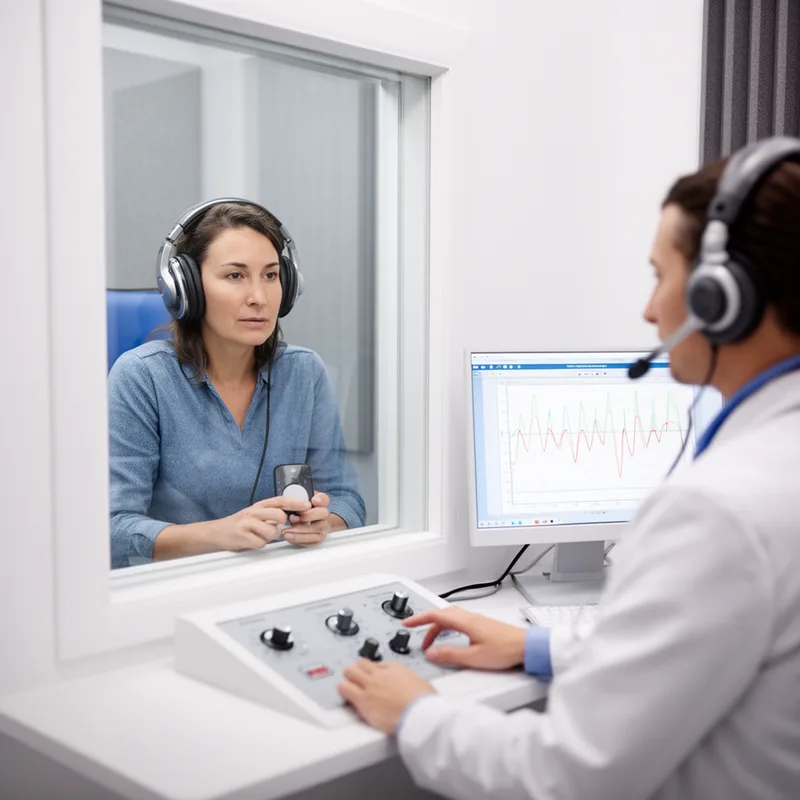
audiometry


 1
7.5
- noun
- /ˌɔːdiˈɑːmətri/
- Specialized
- The doctor recommended audiometry to assess how well I can hear different frequencies.
- pure-tone audiometry
- tone audiometry
- impedance audiometry
Examples
-
We used a visual-reinforcement audiometry technique for the younger children and a conventional technique for the older ones.
Academic text (2001) -
The diagnosis was supported by standard testing, including audiometry, electronystagmography, and electrocochleography.
Academic text (2002) -
These are more sophisticated audiometry tests than I can run here.
-
Findings on repeat audiometry three months later were unchanged, and the patient's speech recognition was poor.
Academic text (2006) -
Electronystagmography and audiometry were performed before and after each patient's treatment course.
Academic text (2003) -
Likewise, we detected no damage to the inner ear as determined by pure-tone audiometry.
Academic text (2005) -
The use of impedance audiometry became popular in 1970, when the A-B-C tympanogram configuration system was described.
Academic text (2004) -
One of the major applications of brainstem audiometry is the determination of hearing thresholds in hard-to-test patients.
Academic text (1995) -
The pulses emanated from a small oscillator (Radioear B-71) that is used in clinical audiometry for bone-conduction testing.
Academic text (2011) -
Predicted behavioral thresholds on ASSR audiometry and measured behavioral thresholds are highly correlated (r > 0.95).
Academic text (2005)
Surface Forms
Morphology
Etymology
Audiometry comes from audi- 'to hear' and -metry 'measure', just like audio is about sound and a thermometer measures temperature. So audiometry means measuring how well someone can hear, which is why it is the name for hearing tests.