
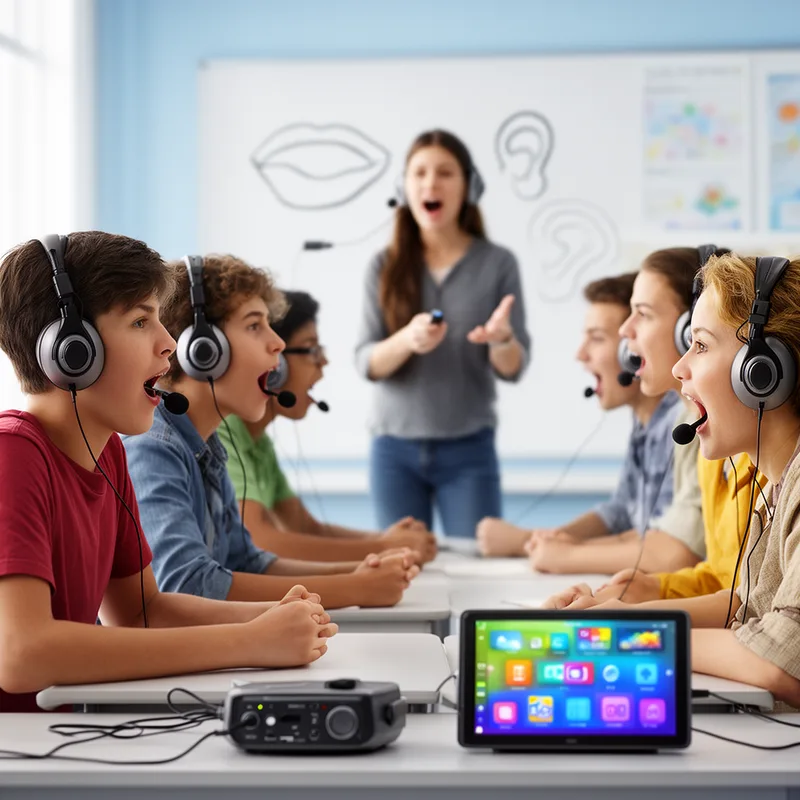
audio-lingual acquisition
- noun
- /ˈɔːdioʊˈlɪŋɡwəl əˌkwɪˈzɪʃən/
- Archaic
- The audio-lingual acquisition approach requires repeated drills and listening exercises.
Examples
-
Many language classes use audio-lingual acquisition techniques to improve students' speaking skills.
-
The audio-lingual acquisition approach focuses on listening and speaking to develop language proficiency.
-
Researchers have debated the effectiveness of audio-lingual acquisition compared to other language learning methods.
-
The audio-lingual acquisition method is effective for beginners.
-
Is audio-lingual acquisition suitable for all ages?
-
Many language classes use audio-lingual acquisition techniques to improve students' speaking skills.
-
Students benefit from audio-lingual acquisition as it emphasizes practical usage through drills and conversations.
How Intensive
 11
5.4
11
5.4


- Archaic
Surface Forms
Morphology
audio-lingual + acquisition
The meaning can be partly derived from the parts: 'audio' (relating to listening) + 'lingual' (relating to language/speech) + 'acquisition' (learning), so a learner who knows those constituents would likely infer it refers to learning language through listening/speaking. However, the hyphenated technical label is a field-specific pedagogical term (Audio‑Lingual Method), so the exact institutionalized sense as a specific teaching method is specialized and not fully predictable to a general B1 learner.
Etymology
Audio-lingual acquisition is named for its focus on audio (hearing) and lingual (tongue or speaking): imagine learners copying sentences from a tape again and again so their ear and tongue learn the patterns. That's why it means a teaching method where students 'learn by listening and speaking' through repeated drills.