
atrioventricular node


 1
7.2
1
7.2
- noun
- /ˌeɪtri.oʊvɛnˈtrɪkjʊlər noʊd/
- Specialized
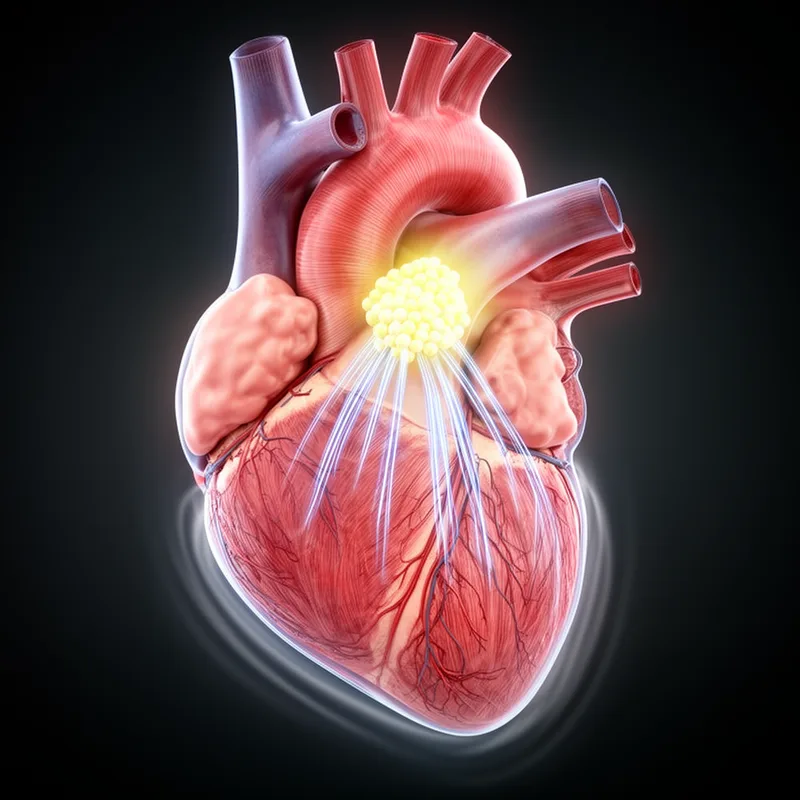
- The electrical signal from the sinoatrial node passes through the atrioventricular node before reaching the heart's ventricles.
- atrioventricular node (AV)
Examples
-
Damage to the atrioventricular node can result in serious arrhythmias affecting the heart's rhythm.
-
Doctors monitor the atrioventricular node to assess how well the heart is coordinating its electrical signals.
-
Atrioventricular node
Academic text (2011) -
We identified maternal cells in the major target organs of NLS: the heart, including the atrioventricular node, and the liver.
Academic text (2003) -
b) Sino-atrial node c) Right bundle branch 3 What is the function of the atrioventricular node?
Academic text (2011) -
The major tissues of interest were the target tissues for inflammatory disease in NLS: the heart, especially the atrioventricular node, and the liver.
Academic text (2003) -
The most serious complication of NLS is inflammation of the atrioventricular node leading to congenital heart block (CHB).
Academic text (2003)
Surface Forms
Morphology
The compound is partly decomposable: 'atrioventricular' (involving atria and ventricles) plus 'node' (a small mass) yields a small anatomical mass related to the atria and ventricles, so its location/structural sense is derivable. However, the specific physiological function (electrical conduction, relation to the sinoatrial node and ventricles) is specialized medical knowledge beyond a B1 learner, so the full meaning is not fully predictable from the parts.
Etymology
Atrioventricular node breaks into atrio- meaning the heart's 'upper' chambers, ventricular meaning the heart's 'lower' chambers, and node meaning a small group. Think of it as a tiny 'station' between the upper and lower chambers that passes the electrical 'signal' to tell the ventricles when to beat, so the name describes its job of moving signals from the atria to the ventricles.