
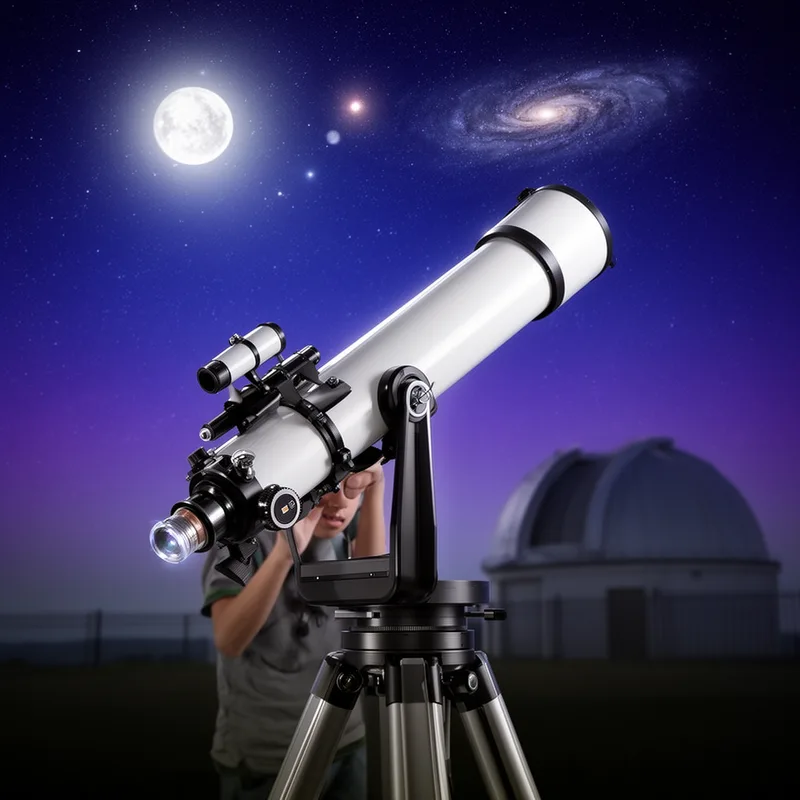
astronomical telescope
 1
5.7
1
5.7

- noun
- /ˌæstrəˈnɑːmɪkəl tɛˈlɛskoʊp/
- Specialized
- A solar array doesn't need near the precision of an astronomical telescope tracking a star.
Examples
-
Better clocks should lead to more capable global positioning systems, more accurate space navigation, and improved control of astronomical telescopes.
Academic text (2005) -
I will first introduce high-energy neutrino detectors as astronomical telescopes by exploring the compilation of astronomical data in Figure 3.
Academic text (2000) -
Be it a human eye, a photographic camera, or an astronomical telescope.
Academic text (1990) -
The use of such a space station as a mounting point for large astronomical telescopes is shown ...
Blog text (3) -
The significance of the dates of these events is that they preceded Galileo's invention of the astronomical telescope.
Academic text (1990) -
Given reasonable efficiencies for a complete astronomical telescope and its optical system, only stars brighter than tenth magnitude can provide the flux needed to precisely monitor the wavefront over areas of diameter about 20 cm and in periods as short as 3 msec.
Academic text (1994) -
The astronomers used an astronomical telescope to discover new stars in the distant galaxy.
-
Thanks to the astronomical telescope, we can collect data on the radiation emitted by black holes.
-
The astronomical telescope allowed scientists to photograph the surface of Mars in unprecedented detail.
Synonyms
 440
3.3
440
3.3
A tool with lenses or mirrors that makes far things look closer
 52
5.0
52
5.0
A large telescope in space that goes around Earth to take pictures of stars and galaxies
 8
4.4
8
4.4
A large dish that receives radio waves from space
 3
7.0
3
7.0
A telescope that uses a large curved mirror to make distant objects look closer
 2
3.8
2
3.8
A machine with lenses or mirrors that gathers and focuses visible light to see distant stars and planets
 1
5.5
1
5.5
A telescope that uses a large curved mirror to gather and focus light for looking
 1
8.8
1
8.8
A simple mirror telescope with a base that moves easily, used by amateur astronomers
 1
6.7
1
6.7
A telescope that uses a large lens to bend light to make images you view through an eyepiece

A telescope for taking pictures of the night sky

A telescope with a mirror and a special curved glass that takes clear photos of wide areas of the sky

A telescope that collects radio waves from space

A telescope that uses mirrors and has an eyepiece at a right angle to the main tube

A telescope that uses two curved mirrors to focus light back through a hole in the main mirror
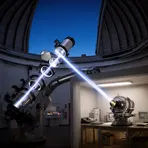
A telescope with mirrors that sends light to a fixed point for a camera or an instrument that measures light

A telescope with a camera that takes pictures of the Sun

A telescope for safely looking at the sun to study sunspots and flares

An early telescope invented by Galileo that uses two lenses to make upright images
How Specialized
- Specialized

- Specialized
1
5.7
- Specialized
47
5.9
- Specialized
4
3.5
- Specialized
5
3.9
- Specialized
608
3.5
Surface Forms
Morphology
The meaning 'a telescope for astronomy' is directly derivable from combining 'astronomical' (related to astronomy/space) with 'telescope' (a device for viewing distant objects). This straightforward adjective + noun composition follows common cross-linguistic patterns, so a B1 learner who knows both constituents would readily understand the phrase.
Etymology
Astronomical telescope is named from astronomical meaning 'about the stars and space' and telescope meaning 'a device for seeing far away'. Long ago people who study the stars used long tubes like this to make distant planets and stars look closer, so the phrase means 'a telescope used to look at space'.