

asterism
 1
9.9
1
9.9

- noun
- /ˈæstərɪzəm/
- The Big Dipper is a well-known asterism that helps people navigate in the night sky.
- asterism in Sagittarius
- asterism of stars
- distinctive asterism
Examples
-
So even the Greeks were using more ancient constellations and asterisms than what they were making up.
-
Look for the asterism formed by the three stars that create Orion's Belt.
-
Here for example is the Chinese way of doing it, and they use much smaller asterisms for setting up their sky.
-
The point is, an asterism, like Kim said, is a more interesting subset of lowest stars that make up the constellation.
-
The Southern Cross is a kite-shaped asterism of four stars: Alpha, Beta, Gamma, and Delta Crucis.
Academic text (2002) -
Others now inconspicuously approaching us may shine more brightly in their places, but a few asterisms may remain recognizable for much longer.
Academic text (1999) -
East of Scorpius, I see the entire Teapot and Teaspoon, asterisms found in Sagittarius.
Blog text (28) -
Mars entered the head of Scorpius the Scorpion and is rapidly climbing the asterism towards the red star Antares, the "Rival of Mars."
Blog text (23) -
The Summer Triangle is a prominent asterism made up of three bright stars: Vega, Deneb, and Altair.
Synonyms
 70
4.8
70
4.8
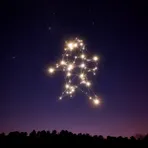
A group of stars that form a pattern in the sky
How Recognizable

Surface Forms
Morphology
asterism = aster (semi-transparent) = aster + ism
Built from 'aster-' (star) + '-ism'; the idea of a group or pattern of stars follows from 'star', but '-ism' here denotes a phenomenon or grouping rather than its more familiar meanings (e.g., doctrines), and 'aster-' as a form is not highly salient to learners.
Etymology
Asterism comes from the Greek root aster meaning 'star', the same root as asterisk. So, a small, clear group or pattern of stars in the night sky, like the Big Dipper, is called an asterism because it forms a little 'star' shape or design.