
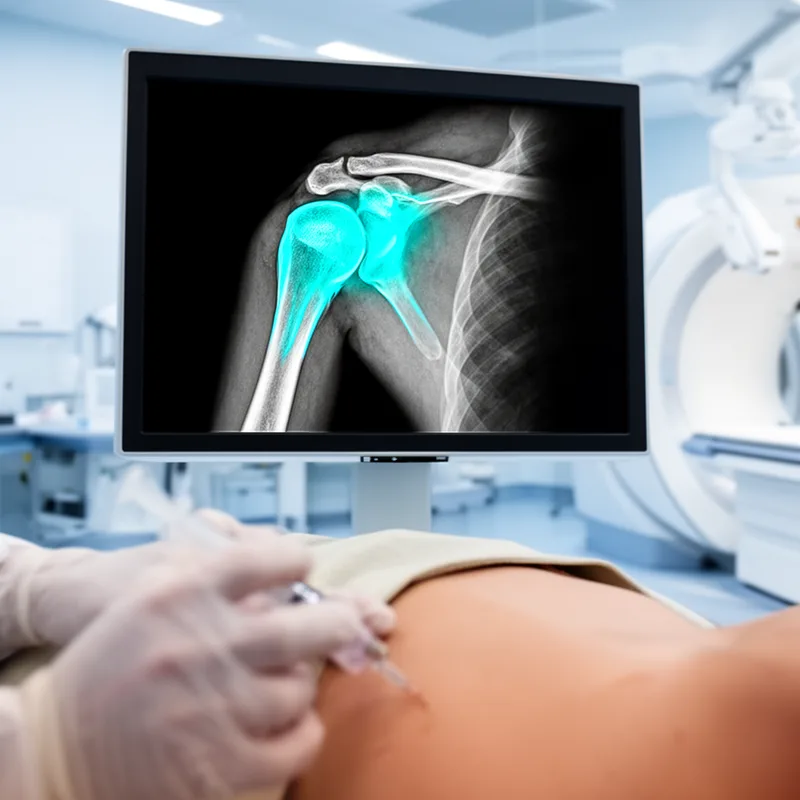
arthrogram


 1
8.5
- noun
- /ˈɑrθrəˌɡrɑm/
- Specialized
- Computed tomography (CT) arthrogram allows for detection of Bankart lesions.
Examples
-
MRI arthrogram improves specificity and accuracy of labral injuries over MRI but requires injection of an IV dye.
Academic text (2003) -
After the arthrogram was completed, the radiologist reviewed the images to assess the condition of my shoulder.
-
Median age at first non-minor procedure (excluding examination under anaesthetic, application of a hip spica, or arthrogram) was almost the same in each group (p=0.45).
Academic text (2002) -
Surgical treatment was defined as any procedure requiring general anaesthesia and was categorised in accordance with the most complex procedure done by 24 months of age, as well as age at first procedure; we did not include examinations under anaesthetic or arthrograms.
Academic text (2002) -
The doctor explained that an arthrogram would help visualize the injury in my knee joint more clearly.
-
For better examination of potential tears, the athletes underwent an arthrogram to enhance the clarity of the joint images.
Synonyms
 1
9.5
An imaging test that takes detailed pictures of a joint after a doctor puts dye into it
How Detailed
- Specialized
1
8.5

- Specialized
1
3.0
Surface Forms
Morphology
arthrogram = arthro + gram
Formed from specialized Greek combining forms ('arthro-' + '-gram'), which are medical terms unlikely to be understood by an average B1 learner from their parts alone.
Etymology
Arthrogram comes from Greek parts arthro- meaning 'joint' and -gram meaning 'a record', and you can see arthro- in arthritis and -gram in telegram. So an arthrogram is literally a 'record' or picture of a joint, which is why doctors use it to make joint problems clearer.