
arthrodesis
- noun
- /ˌɑrθrəˈdiːsɪs/
- Specialized
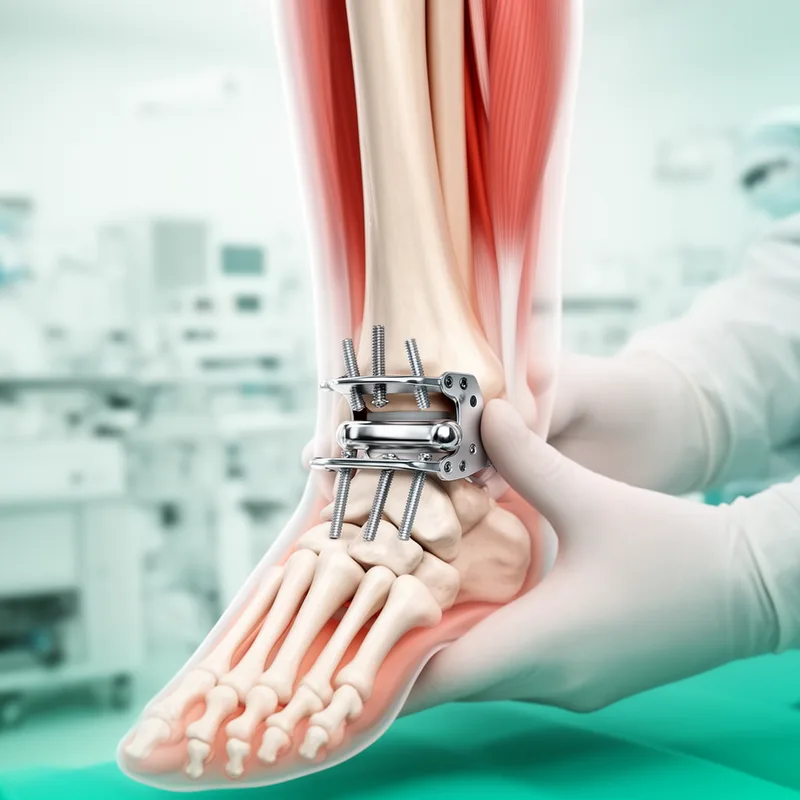
- Arthrodesis is the fusion of a joint and is often performed on the spine, ankle, or other joints where movement is not critical.
Examples
-
She had seropositive RA for 13 years, and further history revealed hypertension and several orthopedic procedures for the RA (i.e., arthrodesis of both ankles and left wrist).
Academic text (2007) -
Common surgical procedures include arthrodesis, trapeziectomy with or without ligament reconstruction and tendon interposition (LRTI), and implants composed of silicone and ceramic.
Academic text (2015) -
For the chronic infection or after failure of other methods, a complete implant removal with arthrodesis is sometimes unavoidable (9).
Academic text (2007) -
For types 3 and 4 subluxation, which are less stable, more invasive treatment is indicated (i.e., halo immobilization, C1-C2 fusion, arthrodesis, etc.).
Academic text (2004) -
An orthopedic surgeon may recommend arthrodesis to eliminate painful movement in severely damaged joints.
-
The doctor suggested arthrodesis to stabilize the joint after the injury and promote healing.
-
Patients suffering from debilitating joint pain may benefit from arthrodesis to fuse the joint and eliminate movement.
How Movement-Limiting


Surface Forms
Morphology
arthrodesis = arthro + desis
Although analyzable as Greek combining forms meaning 'joint' + 'binding', these are not productive standalone English words for an average B1 learner, so the surgical sense is not derivable from the parts.
Etymology
The word arthrodesis comes from two parts that mean 'joint' and 'to bind': arthro- means 'joint', as in arthritis, and -desis means 'to bind'. So, arthrodesis is a surgery that binds a joint so the bones grow together and the joint stops moving, which can reduce pain.