

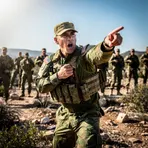
army officer
 9
2.8
9
2.8

- noun
- /ˈɑrmi ˈɔfɪsər/
- The army officer gave clear instructions to the new recruits during their training.
- senior army officer
- regular army officer
- former army officer
Loading YouTube…
Watch on YouTubeAs far as the experience I've had since I've left the farm, I've been an Army officer and deployed to Iraq.
- As far as the experience I've had since I've left the farm, I've been an Army officer and deployed to Iraq.
- And the fact is that a vast wealth of experience was destroyed when large numbers of Red Army officers were executed.
- He went to, he joined the Army, went to OCS, became an Army officer, sent me a text, super freaked out.
Examples
-
Canada had only about 7,000 army officers on strength in 1939.
Academic text (1995) -
Why was the Union army officer going to meet with the conspirators?
Fiction book (1992) -
Are you an army officer?
-
The office is empty; only a few army officers remain.
Fiction book (1997) -
When she reached the Suburban, an army officer extended his hand.
Fiction book (2001) -
The same could be said of the handful of Canadian professional army officers.
Academic text (1995) -
There's an army officer in the other car.
-
For the first time, a high-ranking army officer may soon be tried for this crime.
Blog text (19) -
Spoken like a true army officer.
-
I accepted Islam a year ago while I was an army officer stationed in Somaliland.
Blog text (26)
Synonyms
 ∞
2.4
∞
2.4
A person in the army, navy, or air force who gives orders
 38
3.2
38
3.2
A person in charge of soldiers who gives orders and leads them
How Senior

Surface Forms
Morphology
The meaning 'a person who holds a position of authority in the army' is directly and compositionally derived from 'army' (land forces) + 'officer' (person holding military rank). There is no idiomatic or metaphorical shift and similar constructions exist cross-linguistically, so a B1 learner who knows both words will readily infer the MWE meaning.
Etymology
The noun army officer comes from two simple words: army (a group of soldiers) and officer (someone with an official role who gives orders). Imagine a person in uniform standing before troops and giving orders; that clear image explains why it means 'a person who is in charge in the army'.