

arenaceous rock
- noun
- /ˌɛrəˈneɪʃəs rɑk/
- Specialized
- Much of the desert landscape consists of exposed arenaceous rock that has eroded over time.
Examples
-
The quarry is known for its extensive arenaceous rock formations, ideal for construction.
-
Many arenaceous rocks are formed from ancient riverbeds.
-
Geologists identified a layer of arenaceous rock beneath the clay deposits.
-
The arenaceous rock is found in many coastal areas.
-
Geologists identified a layer of arenaceous rock beneath the clay deposits.
-
Much of the desert landscape consists of exposed arenaceous rock that has eroded over time.
-
The quarry is known for its extensive arenaceous rock formations, ideal for construction.
Synonyms

 18
3.3
18
3.3

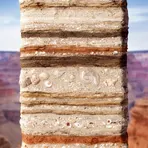
A hard rock formed when sand is pressed and held together over time
 3
3.5
3
3.5
Rock made from layers of sand, mud, or broken shells

A rock made of sand that people use for building and carving
How Sandy


Surface Forms
Morphology
The meaning is directly compositional: 'arenaceous' means 'rich in sand' and 'rock' is a natural solid mineral, so 'arenaceous rock' straightforwardly denotes a rock made largely of sand-sized grains. This follows a regular adjective + noun pattern and would be understandable to a learner who already knows the constituent meanings.
Etymology
The term arenaceous rock comes from the Latin word arena, meaning 'sand', and names a rock made of sand grains stuck together. That's why it means 'a rock made mostly of sand'.