
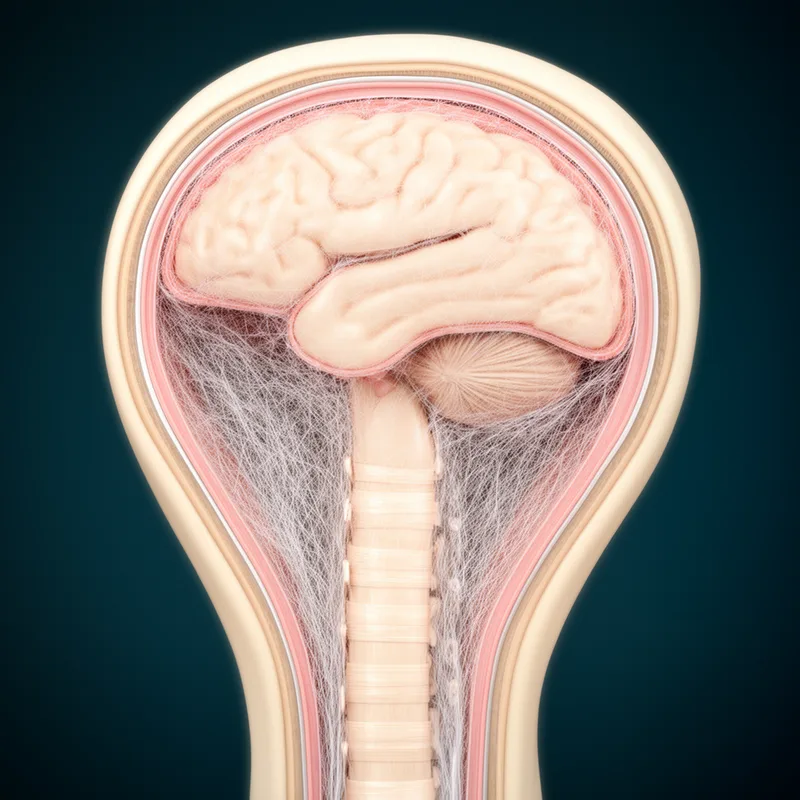
arachnoid membrane
- noun
- /əˈræk.nɔɪd ˈmɛm.breɪn/
- Specialized
- During the surgery, the doctor carefully examined the arachnoid membrane for any signs of damage.
Examples
-
A pressure dressing is applied and left in place untouched for four to five days to prevent movement of the fat and to allow the arachnoid membrane to heal.
Academic text (1996) -
It is not often remarked on that it was Herophilos who first traced the arachnoid membrane into the ventricles of the brain.
-
The arachnoid membrane surrounding the Vth, VIIth, and VIIIth nerves and any blood vessels is opened with blunt dissection or sharp scissors.
Academic text (1996) -
The arachnoid membrane acts as a protective layer between the brain and the outer layers.
-
The arachnoid membrane is essential for cushioning the brain within the skull.
Synonyms

The middle thin layer of tissue that covers the brain and spinal cord
How Delicate


Surface Forms
Morphology
The phrase is directly compositional: 'arachnoid' denotes a web-like (and specifically middle) meningeal layer and 'membrane' means a thin layer, so their combination yields a thin, web-like middle membrane. Although technical, the meaning is predictable from the constituents, so a learner who knows both parts can infer the MWE's sense.
Etymology
The noun arachnoid membrane comes from arachnoid, a word linked to 'spider', and membrane, meaning a thin layer. This middle layer around the brain and spinal cord looks like a spider's 'web', so the name helps you remember it is the thin, web-like layer that protects the brain and spinal cord.