

aquiline
 3
8.4
3
8.4

- adjective
- /ˈakwəˌlīn/
- His nose, which was normally fleshy at the end, now came to seem longish and slightly aquiline, which made him look like a very distinguished Roman senator.
- aquiline nose
- aquiline features
Examples
-
My nose is somewhat aquiline, but not exactly beak-like.
Fiction book (1998) -
Her nose is slightly aquiline, and the ear is well formed.
Academic text (2002) -
The nose was aquiline and strong.
Fiction book (1990) -
The engineer had an aquiline nose.
Fiction book (1999) -
Strong, clever face with a large aquiline nose.
-
But every nose around her is narrow and aquiline.
Fiction book (2001) -
His father's most striking feature, next to his height and a huge aquiline nose, had been his eyes.
Fiction book (1996) -
His fine, aquiline nose.
Fiction book (1999) -
I look for that combination of triangular chin, aquiline nose, blue eyes, and smooth, pale forehead topped by dark hair to match my own.
Fiction book (1995) -
The statue depicted a warrior with an aquiline nose, giving it an imposing presence.
Synonyms
 1
4.4
1
4.4
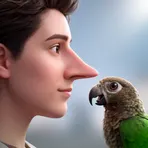
Having a part shaped like a bird's beak

 1
7.2
1
7.2
Having a long pointed nose that looks like a bird's beak

A person with a long curved nose like a bird's beak

Having a sharp curved shape like a hook
Antonyms

How Curved

Surface Forms
Morphology
aquiline = aquil + ine
The adjective is formed from a Latin root meaning 'eagle' plus the adjectival suffix '-ine'; the root is not a productive or recognizable English base, so learners cannot reliably infer 'eagle-like' from the parts.
Etymology
The word aquiline comes from the Latin word aquila, meaning 'eagle', because people thought such a nose looked like an eagle's beak. So aquiline now describes a curved or hooked nose, like an eagle's beak.