
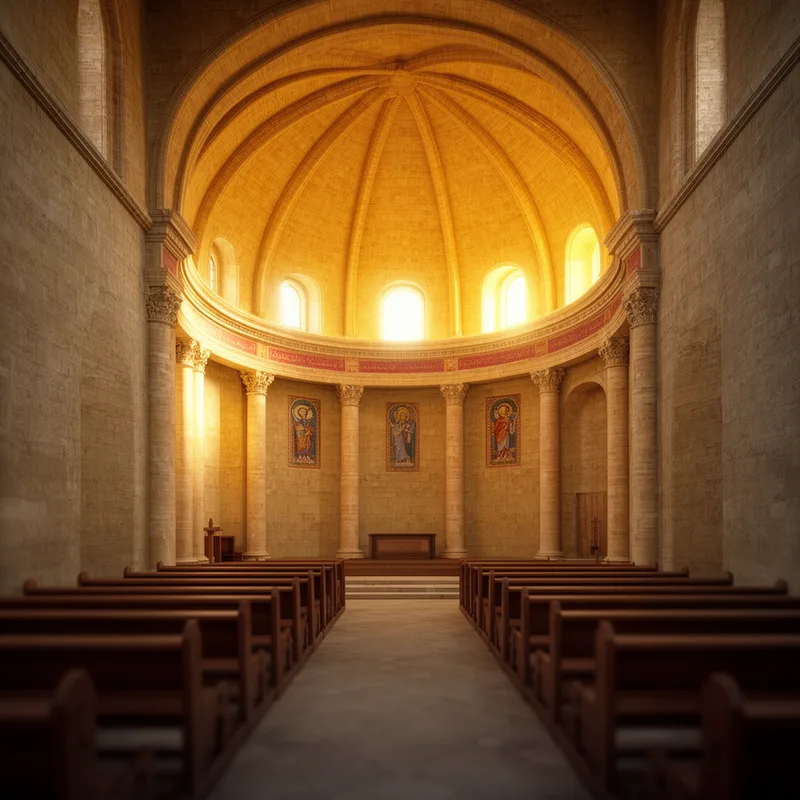
apsidal


 1
9.9
- adjective
- /æpˈsaɪdəl/
- Specialized
- Architects often seek to enhance the aesthetic appeal of buildings by incorporating apsidal elements into their designs.
Examples
-
It appears that on its earlier foundation, an oval or apsidal temple was built (Snodgrass 1994, 486-87).
Academic text (2000) -
They imitated neither Neolithic circular huts nor apsidal houses, which remain specific to Anatolia and southeast Europe from the Neolithic to historical times.
Academic text (2000) -
Most chancel screens are significantly present in apsidal structures and are often late additions to the synagogue.
Academic text (1992) -
Early apsidal houses of Southeast Europe had dominant locations, such as those of the Vucedol hill fort, Baden horizon, at the end of the fourth millennium B.C. (Gimbutas 1991, 373).
Academic text (2000) -
The church features an impressive apsidal design, with a semicircular apse at the eastern end.
-
In Roman architecture, the apsidal shape of the temple was symbolic of the divine, creating a focal point for worship.
Surface Forms
Morphology
Etymology
Apsidal comes from the word apse, the semi-circular 'end' or 'vault' of a church, and from Greek apsis meaning 'arch' or 'loop'. So something apsidal is 'related to' or 'shaped like' an apse, which is why architects use the word for that part of a building.