
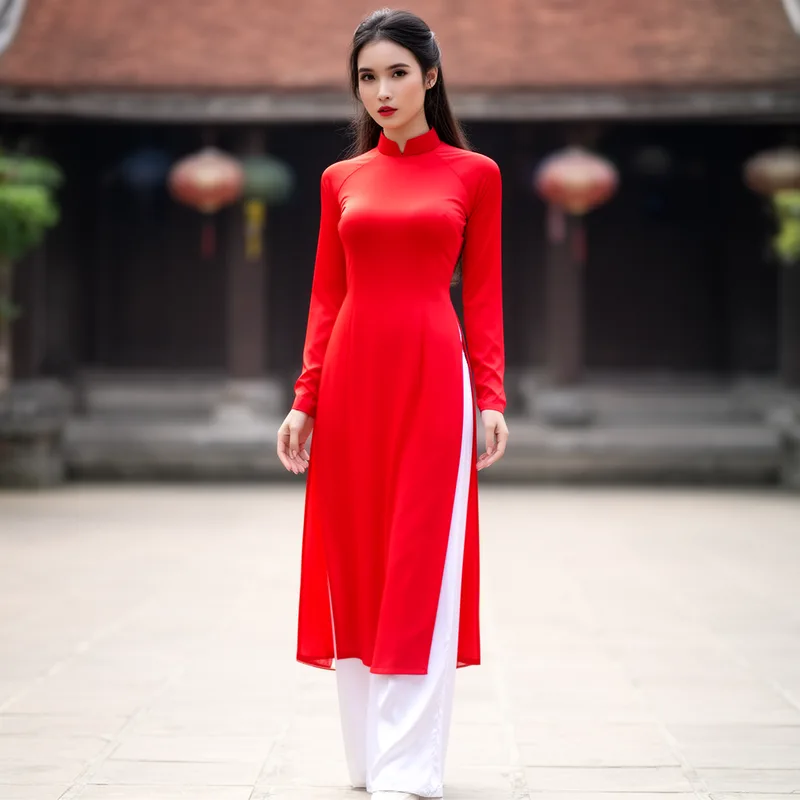
ao dai
 1
9.6

- noun
- /aʊ daɪ/
- "Andrews," she gave her name to the pretty female desk clerk in a white ao dai, the traditional Vietnamese costume of trousers and a slim-fitting long tunic.
- silk ao dai
- white ao dai
- traditional ao dai
Examples
-
I hold an apple, and it fills my hand; it is very smooth, very hard, and red like my favorite ao dai.
Fiction book (1990) -
A waitress in a blue ao dai brings us bottles of Ba Muoi Ba beer.
-
I am there too, and I wear my best ao dai, red like an apple, and my quan, my silk trousers, are white.
Fiction book (1990) -
A waitress in a blue ao dai brings us bottles of Ba Muoi Ba beer.
Fiction book (2000) -
Five young singers in traditional ao dais serenaded us to the accompaniment of five musicians playing traditional instruments.
Fiction book (1991) -
Thuy had a beautiful figure and breasts that were so tempting in the tight bodices of our ao dai that Ly could not resist her.
Fiction book (1992) -
The hair was very soft and yielding to my hands now, and I could see this hair hanging perfectly against the back of her pale blue ao dai as she and Ly strolled away across the square near the Continental Palace Hotel.
Fiction book (1992) -
Then Mai was walking on a beach—a warm breeze from the South China Sea moved under her silk ao dai, her charcoal hair lifting in a current of air.
Fiction book (1999) -
The servers are dressed in the traditional Vietnamese women's dress, the ao dai.
-
In the early evening in Hue, the girls from the secondary schools come home from classes, fleets of them bicycling through the streets, all dressed in white ao dai, trim shirtdresses worn over loose-fitting trousers.
How Formal

Surface Forms
Morphology
ao + dai
Although the supplied dictionary entries are missing, in Vietnamese 'áo' = 'shirt/top' and 'dài' = 'long', so the compound literally means 'long shirt' (a long tunic). This meaning is directly compositional (adjective + noun) and matches the provided gloss, so a learner who knows both constituents would be able to infer the MWE's meaning.
Etymology
Ao dai comes from two Vietnamese words: ao meaning 'shirt' and dai meaning 'long'. So the name paints the picture of a long, fitted tunic with long front and back panels worn over trousers, which is why ao dai refers to the traditional women's dress today.