
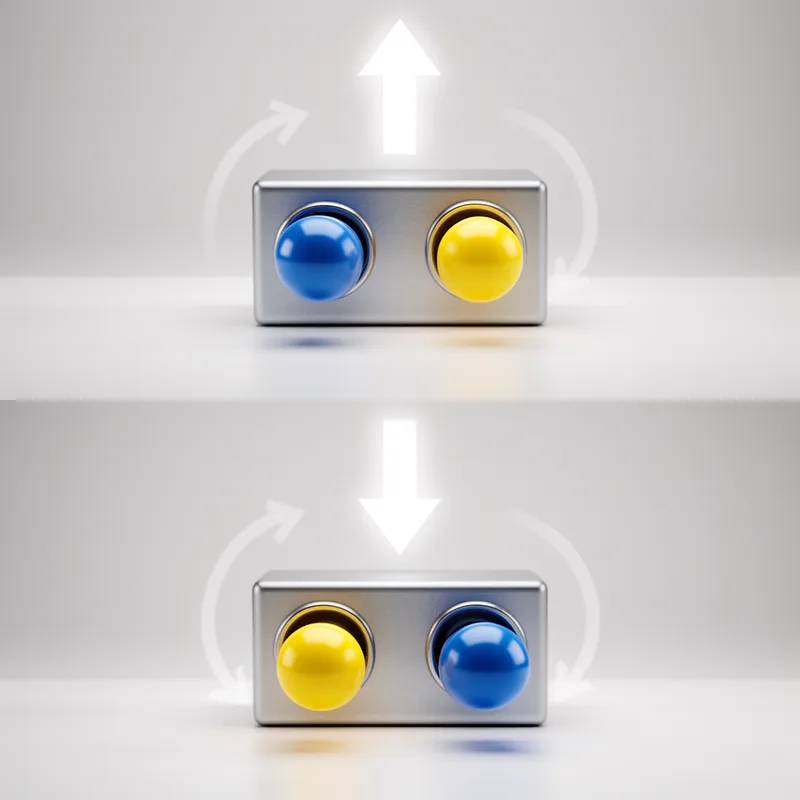
antisymmetric


 1
9.9
- adjective
- /ˌæntiˈsɪmɛtrɪk/
- Specialized
- A function is said to be antisymmetric if swapping its two arguments changes the sign of the output.
Examples
-
Today we know that 3He atoms pair in a p-wave state. Consequently, the total wavefunction is antisymmetric under an exchange of spatial coordinates.
Academic text (2003) -
We know that for a potential like this, the eigenstates of energy are either symmetric or antisymmetric functions.
-
In other words, it is antisymmetric about the origin.
-
It's not necessarily antisymmetric unless you're lucky.
-
Supposing I want to make it antisymmetric on the interchange of the electrons, that's very easy.
-
Mathematically, an antisymmetric relation means that if element A is related to element B, then element B cannot be related to A unless both are the same.
-
In physics, we often look for antisymmetric properties in wave functions when analyzing particle exchanges.
Surface Forms
Morphology
antisymmetric = symmetric (semi-transparent) = anti + symmetr + ic
The form clearly combines anti- with symmetric, but the exact sign-flipping property is a specialized mathematical convention rather than an everyday predictable meaning.
Etymology
Antisymmetric comes from the parts anti- meaning 'against' and symmetric meaning 'same on both sides'. A helpful image is a pair that looks the same but with opposite sign: when you swap the two inputs you get the negative value, which is why f(x, y) = -f(y, x).