
antinode
9.9
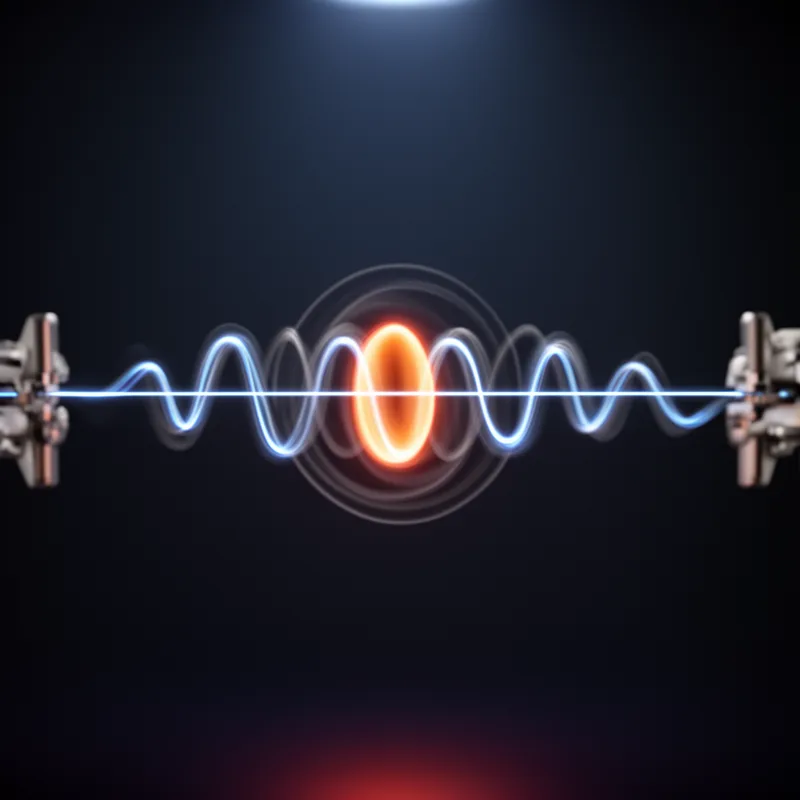
A point in a standing wave where movement is largest
- noun
- /ˈæntɪnoʊd/
- Specialized
:
antinodo
- Moreover, the circuit approach can permanently affix the qubit within the cavity—it's engineered to sit still within the antinode of the standing wave.
Examples
-
In a vibrating string, the points at which the wave has maximum displacement are called antinodes.
-
At frequencies greater than 8 kHz, the quarter wavelength is short enough to produce nodes and antinodes in the ear canal, resulting in varied sound pressure across the surface of the tympanic membrane (21).
Academic text (2001) -
The highest point of constructive interference is called an antinode.
-
When studying waves, it is important to identify the antinode, as it determines where the energy is concentrated.
Antonyms



Surface Forms
Morphology
Etymology
The word antinode is built from anti- 'opposite' and node 'point'. A 'node' is a place that does not move, so an antinode is the opposite place in a standing wave where the string or wave moves the most.