
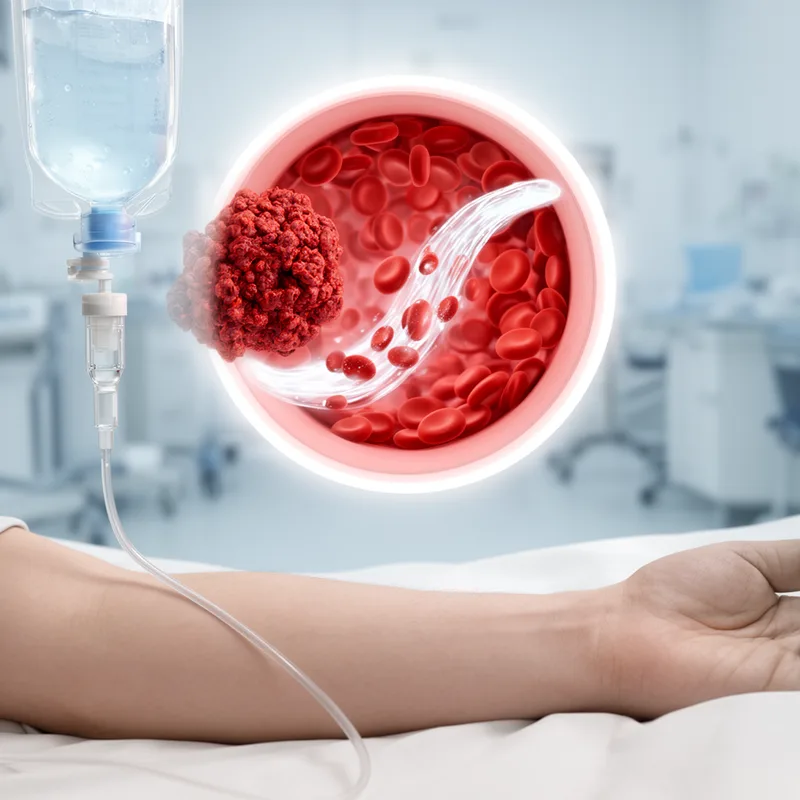
anticoagulation
 1
5.5
1
5.5

- noun
- /ˌæntiˌkoʊəˈɡjʊleɪʃən/
- Specialized
- Warfarin has long been the mainstay of anticoagulation therapy, but newer agents are finding their way into clinical practice.
- anticoagulation with warfarin
- anticoagulation therapy
- anticoagulation clinic
Loading YouTube…
Watch on YouTubeSo, so I think that, you know, it's easy to protect yourself from stroke by taking anticoagulation there.
- So, so I think that, you know, it's easy to protect yourself from stroke by taking anticoagulation there.
- Now we're treating patients with anticoagulation because we are learning as we have bought time from flattening the curve.
Examples
-
Patients with a high stroke risk who are currently receiving aspirin should be considered for anticoagulation.
Academic text (2014) -
Turn to our feature, A Practical Guide to Anticoagulation, page 29.
Academic text (2012) -
A number of new options for anticoagulation are now available.
Academic text (2014) -
Some people will be anxious at the prospect of starting anticoagulation, and these concerns should be recognized and discussed.
Academic text (2015) -
Are each of your AF patients on the most appropriate anticoagulation therapy?
Academic text (2011) -
For most people, then, the benefits of anticoagulation in terms of stroke risk reduction outweigh the risk of bleeding.
Academic text (2015) -
Based on Marianne's history, her CHA2DS2-VASc score would be 4, indicating a clear need for anticoagulation.
Academic text (2015) -
When clinically relevant AF is detected, initiation of anticoagulation could reduce the risk of recurrent stroke in these patients.
Academic text (2014) -
Therefore, DVT prophylaxis with graduated elastic stockings, external compression devices, and anticoagulation should be undertaken.
Academic text (2004) -
The doctor recommended anticoagulation to prevent blood clots in patients with atrial fibrillation.
Antonyms

- Specialized
5
6.9
A change when a liquid becomes thick and forms clots, like blood or milk
How Strong

Surface Forms
Morphology
anticoagulation = coagulation (transparent) = anti + coagul + ation
The word is transparently built as 'anti-' + 'coagulation', meaning against or preventing clotting.
Etymology
Anticoagulation starts with anti- meaning 'against' and has coagulate meaning 'to clot', like when milk curdles into lumps. So anticoagulation is the process used to stop blood from making clots.