

anti-G suit
- noun
- /ˈæn.tiˌdʒiː suːt/
- Specialized
- The pilot wore an anti-G suit to prevent blackouts during high-speed maneuvers.
Examples
-
Astronauts often rely on an anti-G suit to help withstand the intense forces experienced at launch.
-
Modern anti-G suits are tailored to fit comfortably while maintaining maximum effectiveness.
-
The pilot wore an anti-G suit during the flight.
-
Why do astronauts need an anti-G suit?
-
Astronauts often rely on an anti-G suit to help withstand the intense forces experienced at launch.
-
The pilot wore an anti-G suit to prevent blackouts during high-speed maneuvers.
-
Modern anti-G suits are tailored to fit comfortably while maintaining maximum effectiveness.
Synonyms


 1
7.4
1
7.4
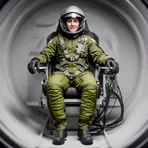
A tight garment worn by pilots and astronauts that presses the body to prevent fainting during fast turns
How Protective
- Specialized
4
7.3

- Specialized
Surface Forms
Morphology
anti-G + suit
The compound clearly combines 'anti-' (against) with 'suit' (a garment), so a learner can infer it is a garment intended to oppose something. However the central element 'G' is a technical abbreviation for gravitational/G‑force that many B1 learners may not know, so the precise function (counteracting G‑forces during acceleration) is not fully predictable without domain knowledge.
Etymology
Anti-G suit gets its name from its parts: anti means 'against' and G stands for the strong pull called 'G' or 'G-force', and suit is the special clothing. The tight suit squeezes the legs and stomach to keep blood near the brain during fast turns or when speed increases, so it helps pilots and astronauts avoid blackouts.