

anthropoid


 1
8.0
1
8.0
- noun
- /ˈænθrəˌpɔɪd/
- Specialized
- It’s an arboreal anthropoid of the genus papio.
- group of anthropoids
- living anthropoids
- early anthropoids
Examples
-
Since early fossil Old World anthropoids also had small brains, this skull provides strong evidence that brains expanded independently in the Old and New World anthropoid primates.
Academic text (2009) -
Based on the fossil, Chilecebus is estimated to have weighed about one and one-third pounds and to have had a smaller brain relative to its body size than any living anthropoid.
Academic text (2009) -
Stand at any corner and listen to the jumper, the local anthropoid.
-
For this behavior to be a cause of bipedalism, it must have begun while they were still quadrupedal anthropoids.
Academic text (1995) -
Most of the features distinguishing humans from apes are unique not only among anthropoids but also among all primates; some are unique among land mammals.
Academic text (1995) -
Living anthropoids include species such as monkeys, apes, and humans.
-
Researchers study ancient anthropoids to understand primate evolution.
-
In the zoo, we observed different types of anthropoids interacting with each other.
Synonyms
 65
4.0
65
4.0
A mammal like a monkey, ape, or human

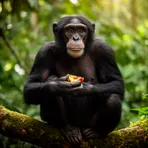
A large tailless animal like a gorilla or chimpanzee that is more like humans than other monkeys
Compounds
- Specialized
A large tailless animal like a gorilla or chimpanzee that is more like humans than other monkeys
Surface Forms
Morphology
anthropoid = anthropo + oid (semi-transparent) = anthrop + oid
The components 'anthropo' and 'oid' are clear, but the specific biological meaning requires specialized knowledge.
Etymology
Anthropoid comes from an old Greek word anthropos meaning 'human' and the ending -oid meaning 'like' or 'shape'. So an anthropoid is a 'human-like' primate, the group that includes monkeys, apes, and humans.