

anthelmintic
- adjective
- /ˌænθəˈlɛmɪntɪk/
- Specialized
- Anthelmintic drugs now help to prevent infestations.
- anthelmintic drugs
- anthelmintic treatment
- anthelmintic resistance
Examples
-
The current strategy of engaging in seasonal use of anthelmintics is the key to arresting the disease and overcoming anthelmintic resistance.
Academic text (2015) -
This enables us to focus anthelmintic treatments at times when adequate refugia are present.
Academic text (2015) -
Treating with an anthelmintic four times a year is effective against young parasites, but there are few marked places where it will be feasible.
Academic text (2014) -
The underdosing is the major cause of anthelmintic resistance (Toscan et al., 2012).
Academic text (2015) -
Usually, equines are treated with anthelmintic drugs to eliminate adult strongyles from the large intestines to prevent excessive contamination of pastures with eggs and L3s.
Academic text (2015) -
The emergence of anthelmintic resistance demands review of old studies. Development and Life Cycle: All species of equine strongyles have direct life cycles (Bucknell et al., 1995; Osterman, 2005; Kuzmina, 2006; Martin et al., 2007).
Academic text (2015) -
Although anthelmintic treatment is effective against fasciolosis, this is an expensive and non-sustainable measure, and drug-resistant strains have been reported (Brennan et al., 2007; Overend and Bowen, 1995).
Academic text (2014) -
Faecal egg counts are useful for comparing the efficacy of anthelmintic compounds, detecting drug resistance, and determining the correct gap between anthelmintic treatments (Herd, 1992; Warnick, 1992).
Academic text (2015) -
Faecal egg counts are useful for comparing the efficacy of anthelmintic compounds, detecting drug resistance, and determining the correct gap between anthelmintic treatments (Herd, 1992; Warnick, 1992).
Academic text (2015) -
The veterinarian prescribed an anthelmintic to treat the horse's worm infection.
Synonyms

Able to kill or remove parasitic worms from the body
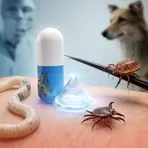
Able to kill worms and tiny animals that live on or inside people and animals
How Effective


Surface Forms
Morphology
anthelmintic = helminthic (opaque) = anti + helminth + ic
The derivation from 'helminthic' with anti- is structurally analyzable, but the technical base word is unlikely to be known by a typical B1 learner.
Etymology
Anthelmintic comes from Greek parts anti- 'against' and helminth 'worm', the same anti- you find in antibiotic. That's why when we call a drug anthelmintic, we mean it can destroy or remove parasitic worms.