

anion
 1
6.7
1
6.7

- noun
- /ˈæn.aɪ.ən/
- Specialized
 :
anión
:
anión
- Sodium chloride is composed of sodium cations and chloride anions that balance each other's charges.
- superoxide anion
- anion transport
- anion exchanger
Examples
-
Sodium chloride exists as sodium cations and chloride anions, whereas magnesium is divalent.
-
And these are the negatively charged ions or anions that are in the extracellular space.
-
In fact, usually when I draw these things, I leave out the anion and we draw it just like that.
-
The unaffected family member showed normal anion transport activity.
Academic text (1996) -
The capillary water holds the anions in solution for the plants.
Blog text (21) -
At this moment, seedlings always accumulate a large number of organic acids to compensate for the anion deficit caused by high pH.
Academic text (2014) -
In the activation process, the hydroxyl anions act as a reaction catalyst, while the alkali metal cations act as structure-forming elements.
Academic text (2017) -
Escobosa et al. reported that milk production reduced when cows were supplemented with anions (2.28% CaCl₂).
Academic text (2018) -
During the experiment, we observed how the anion moved towards the positive electrode in the electric field.
-
The presence of an anion in the solution indicates that the substance has gained extra electrons.
Antonyms

- Specialized
1
7.6
A positively charged part of an atom made when it loses electrons, like sodium or potassium
Compounds
- Specialized
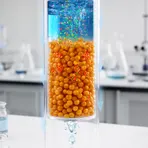
A man-made material that removes negatively charged ions from water

Surface Forms
Morphology
Etymology
Anion comes from a Greek root meaning 'up' because, in early electrical experiments these negatively charged particles were seen to move 'up' toward the positive side called the anode. So an anion is an atom or molecule that has gained one or more electrons and therefore has a negative charge.