
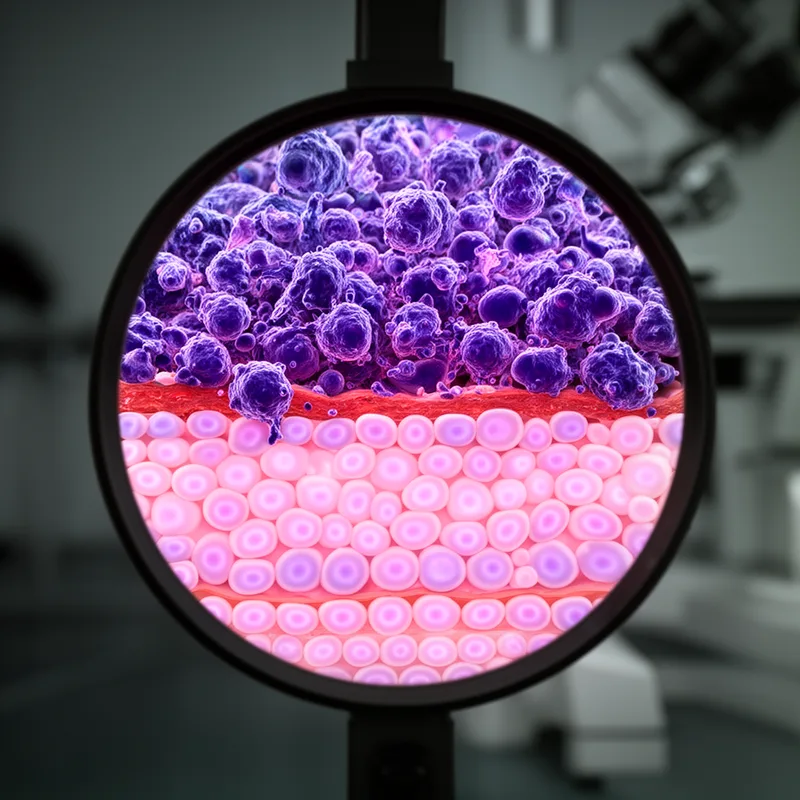
anaplastic
 1
9.9

- adjective
- /ˌænəˈplæstɪk/
- Specialized
- Anaplastic tumors often show a loss of normal cell structure, leading to aggressive behavior in patients.
- anaplastic lymphoma
- anaplastic cells
- anaplastic large
Examples
-
While highly differentiated forms resemble hemangiomas, it is difficult to distinguish the anaplastic types from carcinoma or melanoma.
Academic text (2007) -
More recently, a subtype of anaplastic large-cell lymphoma has been described in which malignant cells are confined to a seroma within the capsular pocket.
Academic text (2014) -
That includes anaplastic thyroid cancer, which now can be treated.
-
'It's an angry-looking anaplastic tumor.'
-
Claudin-1 is a tight junction-associated protein recently shown to be expressed in anaplastic meningiomas.
Academic text (2007) -
Claudin-1 is a tight junction-associated protein that has recently been shown to be expressed in anaplastic meningiomas.
Academic text (2007) -
Most of these have been T-cell in origin; 35 were anaplastic large-cell lymphoma.
Academic text (2014) -
Total thyroidectomy eliminates the possibility of anaplastic transformation of the residual thyroid gland.
Academic text (2002) -
Since 1997, reports from the scientific community have suggested a possible association, without causation, between breast implants and anaplastic large cell lymphoma (ALCL).
Academic text (2015) -
Stroma usually predominates with cells appearing spindled and polymorphic, with pleomorphic and anaplastic nuclei.
Academic text (1995)
Antonyms

How Differentiated

Surface Forms
Morphology
Etymology
Anaplastic comes from Greek parts ana- meaning 'again' and plastic meaning 'to shape', as in the everyday word plastic, which can be shaped. In medicine it describes cells that have lost their normal shape and role and seem to be shaped again into an earlier, less special form, which is why anaplastic tumors often grow and spread faster.