
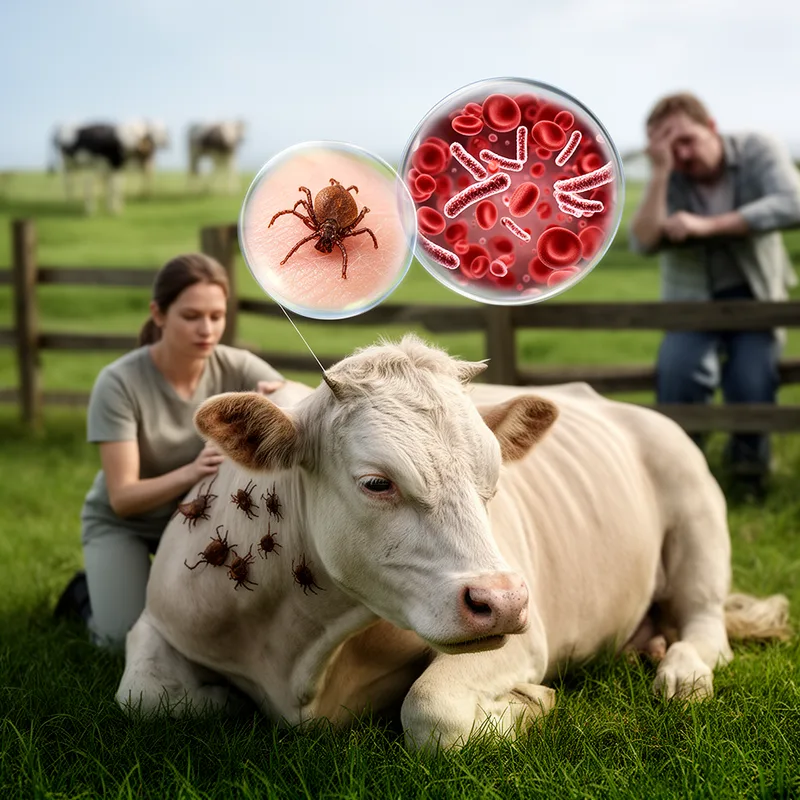
anaplasmosis


 1
9.9
- noun
- /ˌænəplæzˈmoʊsɪs/
- Specialized
- Starting with the earlier advances in anaplasmosis, Golf has been searching since 1982 for an improved vaccine for bovine babesiosis, another tick-borne disease caused by a protozoan that attacks red blood cells.
- granulocytic anaplasmosis
- human anaplasmosis
- anaplasmosis—a disease
Examples
-
Domestic pets can become seriously ill from the tick-borne diseases, borreliosis, babesiosis, and anaplasmosis.
Academic text (2014) -
To help ranch managers deal with diseases like anaplasmosis, which is estimated to be responsible for 50,000 to 100,000 cattle deaths per year, ARS has developed better diagnostic tests.
Academic text (2003) -
Anaplasmosis is not only a health issue for cattle, it's a trade issue.
Academic text (2003) -
Canada recently adopted the ARS test as its national standard for anaplasmosis diagnosis.
Academic text (2003) -
However, anaplasmosis is thought to cost ranchers up to $300 million annually.
Academic text (1994) -
Fast, accurate tests, based on antibody testing technology, were developed for trichinosis in pigs, for anaplasmosis, a costly parasitic disease in cattle, and for plant viruses and viroids.
Academic text (2001) -
This has a bearing on when cases of Lyme disease, TBE, and anaplasmosis are likely to present, due to the incubation period of the organisms concerned: if peak tick activity occurs in mid-to-late August, for example, the number of consultations for Lyme disease may be expected to peak in early to mid-September.
Academic text (2014) -
The vet explained that anaplasmosis is a disease spread by ticks that can severely affect livestock.
-
Farmers must monitor their cattle for signs of anaplasmosis, especially during tick season.
-
The effects of anaplasmosis can lead to significant economic losses for ranchers if not controlled.
Surface Forms
Morphology
Etymology
Anaplasmosis comes from the name of the bacteria Anaplasma, built from Greek parts ana- ('again' or 'up') and -plasma ('form' or 'thing formed'), with plasma like the English word plasma, as in blood plasma. So the name suggests a change in the formed parts of the blood, which fits because this disease attacks and changes red blood cells and causes anemia.