
anaphase
 1
8.8

- noun
- /ˈænəˌfeɪz/
- Specialized
- Cohesin is a protein that binds sister chromatids together, and its degradation allows the sisters to be pulled apart in anaphase.
- poles during anaphase
Examples
-
McEwen and colleagues (1997) determined that in PtK cells, the number of microtubules attached to each kinetochore increases from prometaphase to anaphase.
Academic text (2009) -
The SAC prevents the transition from metaphase to anaphase until proper alignment and tension are detected by a series of proteins.
Academic text (2009) -
Protein functional studies have revealed new information about anaphase movement and the function of motor proteins.
Academic text (2009) -
After the SAC is satisfied, anaphase is initiated.
Academic text (2009) -
Sliding of overlapping midzone microtubules to move apart the spindle poles (anaphase B).
Academic text (2009) -
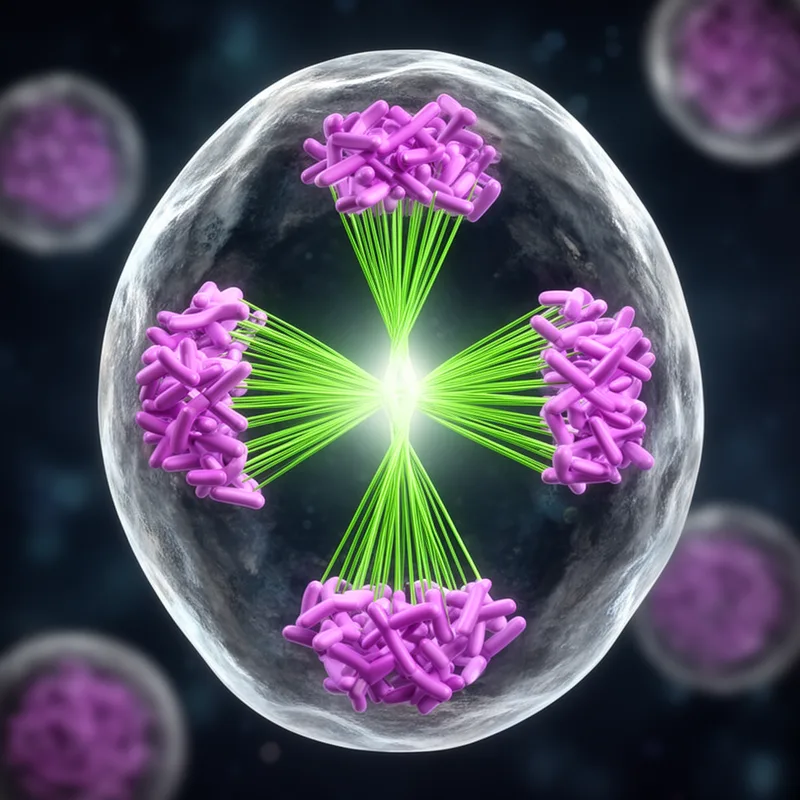
During anaphase, the chromosomes are pulled to opposite ends of the cell by the spindle fibers.
-
In a typical cell cycle, anaphase follows metaphase and is crucial for proper chromosome separation.
-
During anaphase, each sister chromatid is drawn towards the spindle poles, ensuring accurate cell division.
Surface Forms
Morphology
Etymology
Anaphase comes from the Greek parts ana- 'up' or 'back' and phase 'stage', and it uses the same idea of phase you know in English. So, anaphase is the stage in cell division when the chromosomes are pulled apart toward the two ends of the cell.