
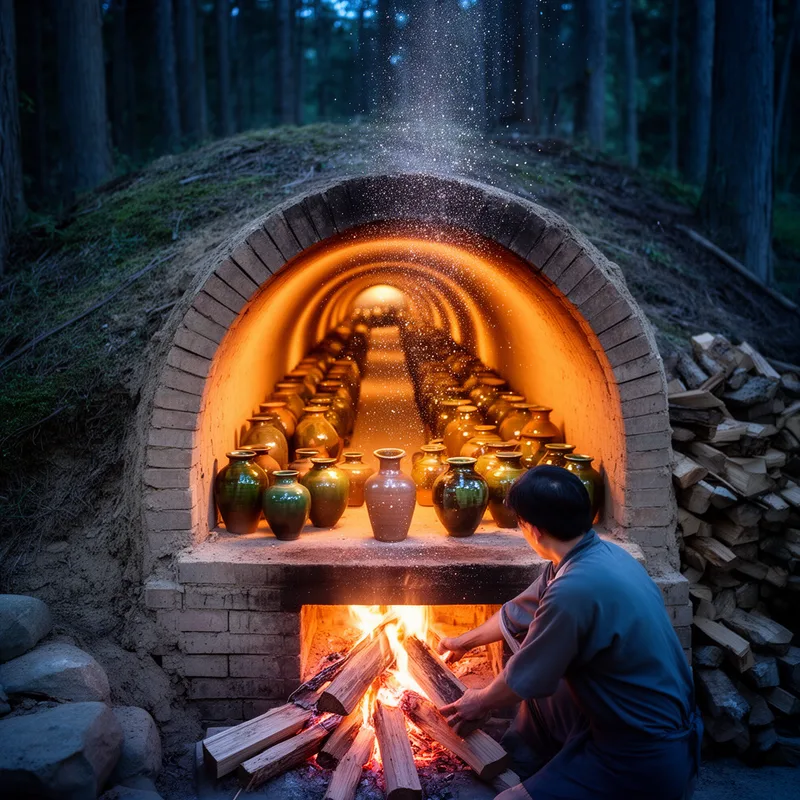
anagama


 1
9.9
- noun
- /ˈænəˌɡɑːmə/
- Specialized
- All anagamas are cross-draft kilns; air enters at one end, passes through a ware chamber, and exits through a flue.
- anagama kiln
- anagama firing
- anagama ware
Examples
-
Selecting or mixing clay for an anagama firing is like setting out the two-by-fours for a house.
Fiction book (1998) -
Anagama firings, therefore, tend to be long, from a few days to a month or more.
Fiction book (1998) -
Traditional anagamas are loaded through the front fire door.
Fiction book (1998) -
Traditionally, anagama firings start out slowly.
Fiction book (1998) -
(The distinctive character of an anagama pot comes largely from its contact with gases and ash from mineral-laden wood bark.)
Fiction book (1998) -
The Japanese contend that in the best anagamas, this last layer always cracks in a pattern like a turtle's shell.
Fiction book (1998) -
Although the Japanese are generally credited with perfecting the anagama kiln, the design is Korean, brought over to Japan perhaps as early as the fifth century.
Fiction book (1998) -
Anagama kilns like Jack's, wood-burning tubular chambers built on a gentle slope to promote draft, burn hot enough to fire porcelain.
Fiction book (1998) -
The weather, especially the wind, is one of the uncontrolled natural elements that help form anagama ware; in the stacking and in the stoking of the kiln, however, one can't miss the clear assertion of human will.
Fiction book (1998) -
At the workshop, the potters carefully selected the clay that would be used in the anagama to ensure beautiful glaze effects.
Synonyms
 16
6.3
A hot oven for drying and making things like pottery or bricks hard
How Traditional
- Specialized
1
9.9

- Specialized
16
6.3
Surface Forms
Etymology
Anagama comes from the Japanese parts ana 'hole' and gama 'kiln', so it means a 'hole-kiln' or cave-like oven. That's why an anagama is a traditional wood-fired kiln where wood ash and smoke fall on the pots and create the special natural glazes people admire.