
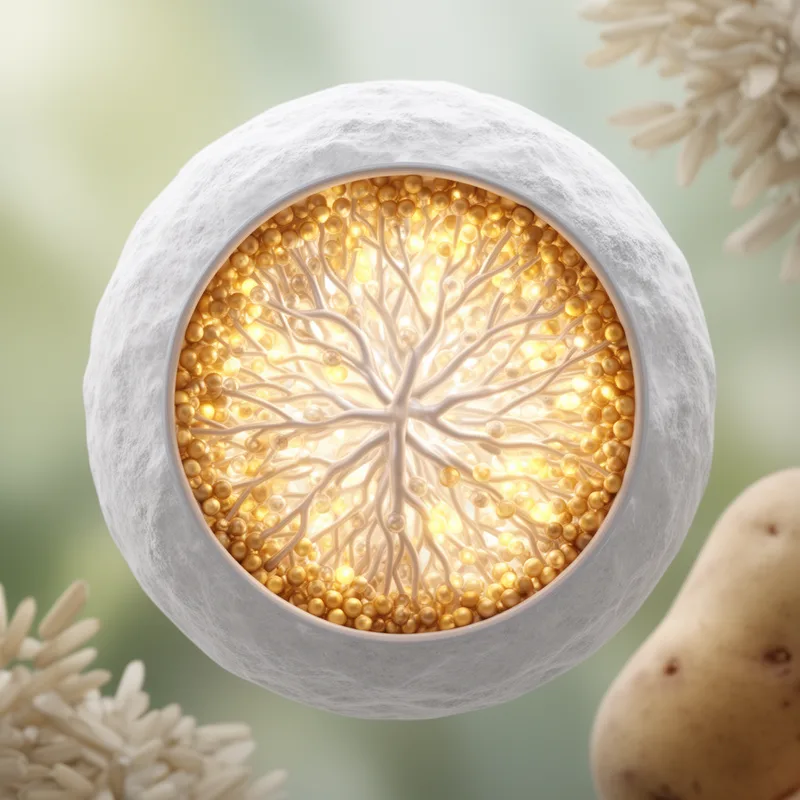
amylopectin


 1
8.9
- noun
- /ˌæmɪloʊˈpɛktɪn/
- Specialized
- Starch is made of about 70% amylopectin, which contributes to its thickening properties.
- amylopectin starch
Examples
-
In plants, amylopectin serves as a major form of stored energy, alongside amylose.
-
Now animals don't make starch, animals don't make amylopectin, but animals make another molecule called glycogen.
-
In nature, starch is a granular crystal comprising two kinds of polysaccharide: a linear form called "amylose" and a branched form called "amylopectin."
Academic text (2005) -
Amylopectin, the rice compound in the mortar, provides mechanical strength and stability, and inhibits the growth of calcium carbonate crystals, resulting in a more compact and resilient binding material.
Academic text (2010) -
Short-grain rice is favored for sushi due to its high amylopectin content, making it sticky when cooked.
Surface Forms
Morphology
Etymology
Amylopectin breaks into amylo- meaning 'starch' and pectin, the same word as the jam ingredient that comes from an old word meaning 'to set'. So amylopectin is the part of plant starch that helps make a thick, sticky structure, which explains why foods high in it can be gluey when cooked.