
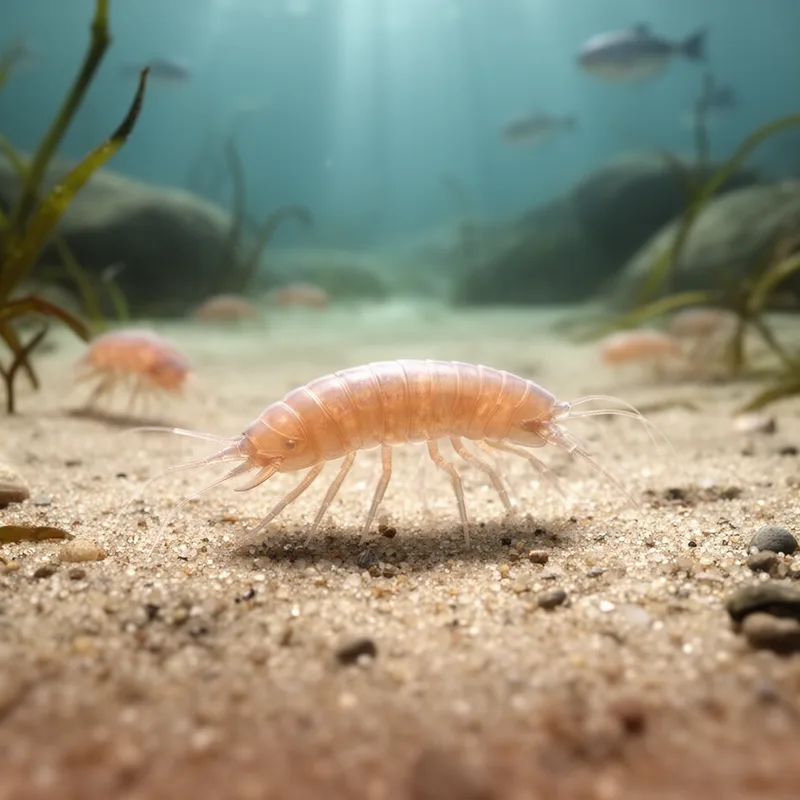
amphipod


 1
9.9
1
9.9
- noun
- /ˈæmfɪˌpɒd/
- Specialized
- The small amphipod wriggled in the water as it searched for food among the rocks.
- gammarid amphipods
- amphipods (crustaceans)
- amphipods resemble tiny shrimp
Examples
-
To the untrained eye, larval cephalopods resemble alien heads, krill look like diminutive shrimp, and amphipods look like tiny pill bugs.
Academic text (2011) -
The investigated amphipod species did not involve endangered or protected species.
Academic text (2018) -
Amphipod species were kept separately in both the acclimation period and experiments.
Academic text (2018) -
There are thirty-three species of amphipods in Admiralty Bay alone.
Academic text (1992) -
High physiological activity of the amphipods was observed during acclimation.
Academic text (2018) -
In 2012, scientists discovered a super-giant, a type of amphipod, in the Kermadec Trench.
Blog text (33) -
The numerous species of amphipods in Lake Baikal represent one group of dominant benthic macroinvertebrates.
Academic text (2018) -
Analyses indicated that near-field sediments were toxic to amphipods (crustaceans).
Academic text (2009) -
Gray whales play an important role in Arctic ecosystems because they bulldoze shallow sediments while feeding on benthic amphipods.
Academic text (2008) -
Researchers studied the impact of pollution on the amphipods living in the river.
Surface Forms
Morphology
amphipod = pod (opaque) = amphi + pod
The parts are scholarly combining forms used in scientific names and are not productive or familiar to average B1 learners, so the zoological meaning is not derivable from common English vocabulary.
Etymology
Amphipod comes from Greek parts amphi- meaning 'both' and -pod meaning 'foot', the same pod you see in tripod ('three feet'). It names a small, shrimp-like animal with different kinds of legs on each side, so the name helps you remember it as a creature with 'feet on both sides'.