
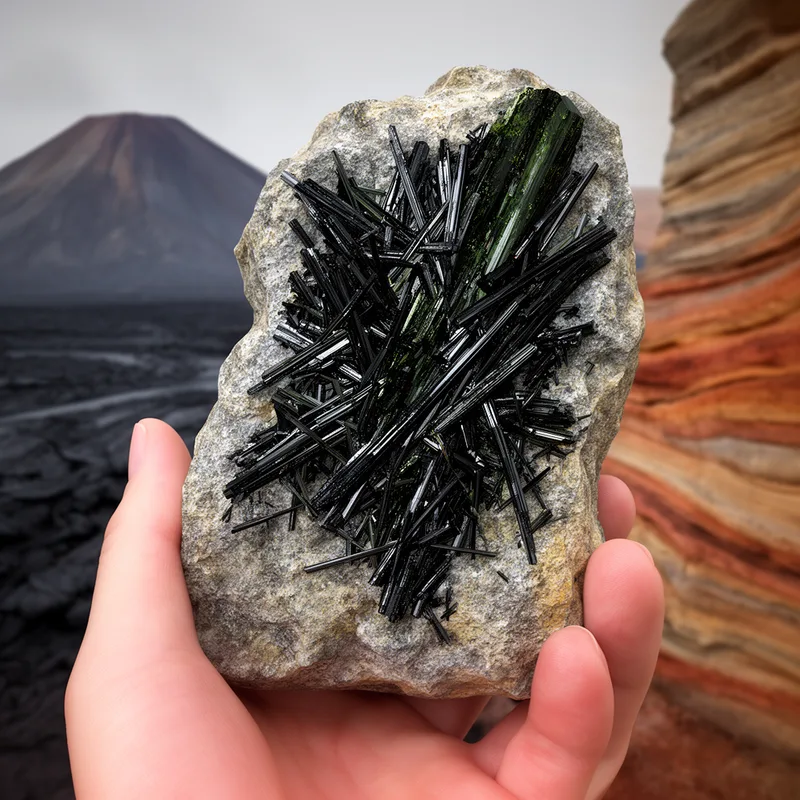
amphibole


 1
9.9
- noun
- /æmˈfɪboʊl/
- Specialized
- Dark-colored minerals known as amphibole, such as hornblende, are often found in granite and other igneous rocks.
- amphibole asbestos
- amphibole fibers
Examples
-
The full "Agree:Disagree" tables for Libby Amphibole Asbestos, and Trichloroethylene are available in appendix B.
Academic text (2017) -
The amphibole asbestos is a carcinogenic sort, not the white chrysotile, which is being extracted in the town of Asbest (it's not the Bazhenovo, by the way).
Blog text (5) -
The dominant mineral is kaersutitic amphibole, set in dark vesicular glass.
Academic text (2018) -
In addition to the vermiculite product, the exfoliation produced a waste material that contained up to 10% amphibole asbestos (Minnesota Department of Health (MDH) 2005).
Academic text (2012) -
The dominant mineral is kaersutitic amphibole (Amp), set in vesicular glass (with examples of the glass and vesicles also indicated).
Academic text (2018) -
Note that the smallest amphibole grains are more rounded than the larger grains, which preserve large areas of planar growth faces, indicating a limited approach to the minimum-energy shape.
Academic text (2018) -
John's analysis determined that the black material is the mineral arfvedsonite, an amphibole similar to hornblende, with a composition of Na3(Fe, Mg)4FeSi8O22(F, OH)2.
Blog text (21) -
Geologists study amphibole to understand the formation of metamorphic rocks in mountain ranges.
-
The presence of amphibole in the rock sample indicates a high temperature of formation.
Synonyms

A group of minerals in rocks with similar crystal shapes that contain metals like iron and calcium
Compounds
- Specialized
A group of minerals in rocks with similar crystal shapes that contain metals like iron and calcium
Surface Forms
Etymology
Amphibole comes from the Greek part amphi- meaning 'both', the same amphi- you see in amphibian, an animal that lives in water and on land. This is a helpful memory because amphiboles are silicate minerals made of 'two' linked chains, so the name points to their double-chain structure.