

amoeboid


 1
8.9
1
8.9
- adjective
- /əˈmiːbɔɪd/
- Specialized
- Paulinella chromatophora (Fig. 4a) is an amoeboid protist that acquired an organelle-like cyanobacterial endosymbiont similar to 100 million years ago.
Examples
-
The dinoflagellates then consume the dead fish tissue and return to the sediment, where they undergo an extremely complex life cycle involving multiple amoeboid, gametic, and cystic stages (Burkholder and Glasgow 1997).
Academic text (2000) -
In this article, we review the physics behind eukaryotic chemotaxis using a model system: the crawling motion of the amoeboid Dictyostelium discoideum.
Academic text (2012) -
The artist created amoeboid sculptures that seemed to shift shape under the changing light.
-
When viewed under a microscope, the amoeboid cells moved fluidly, changing their form as they navigated through the slide.
-
The planet's surface featured amoeboid landforms that appeared to continuously reshape due to erosion.
Synonyms
 1
7.9
1
7.9
Relating to or caused by amoebas, tiny single cells that can make people sick
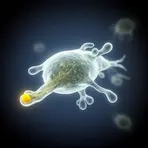
Having a soft shape that changes to move like an amoeba
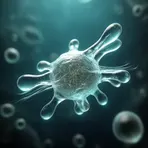
Looks or moves like an amoeba
How Irregular

Surface Forms
Morphology
amoeboid = amoeba (semi-transparent) = amoeba + oid
Formed from 'amoeba' + the suffix '-oid' meaning 'resembling'; the meaning is direct but the technical suffix may be unfamiliar to many learners.
Etymology
The word amoeboid comes from amoeba, an old Greek word meaning 'change', and the ending -oid, which means 'like' and appears in words such as humanoid. So amoeboid means 'like an amoeba', which helps you remember it describes something that changes shape or moves in a soft, flowing way.