
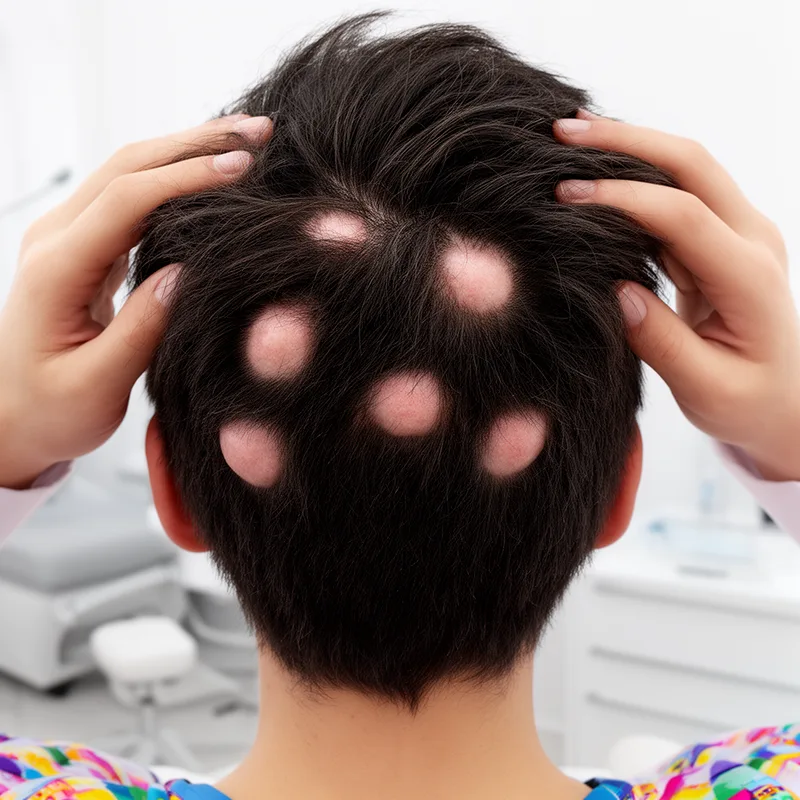
alopecia areata


 1
6.7
1
6.7
- noun
- /ˌæloʊˈpiːʃə əˈriːətə/
- Specialized
- The hair loss can be either partial, a condition often termed alopecia areata, or complete, leaving a bald head.
- alopecia areata causes hair loss
Examples
-
Alopecia areata has a rapid onset that leaves a sharply defined round or oval bald area and can occur in children or adults.
Blog text (18) -
Besides, alopecia areata is also prevalent among women.
Blog text (32) -
I was suffering from what my dermatologist called alopecia areata, which means areas of hair loss.
Fiction book (2000) -
A hair loss condition that dermatologists frequently see is alopecia areata.
Blog text (18) -
Alopecia areata is also a T-cell-mediated disorder directed at anagen hair follicles and presenting with non-scarring patchy hair loss that can progress to total alopecia.
Academic text (2007) -
Aalopecia areata causes patches of hair loss on the scalp and may affect other areas of the body.
-
My friend developed alopecia areata, which led to noticeable spots of baldness on her head.
-
Doctors often discuss alopecia areata when explaining certain types of hair loss that occur suddenly.
Synonyms
 4
8.1
4
8.1
Loss of hair from the head and sometimes the body after illness or treatment
How Severe

Surface Forms
Morphology
alopecia + areata
The term is compositionally built from 'alopecia' (hair loss) plus the qualifier 'areata' (from Latin, meaning 'in patches' or localized areas), so the combined sense is simply hair loss occurring in small round patches. Although 'areata' is a specialized/rare medical element, if a learner knows the meanings of both constituents the overall meaning is directly derivable and therefore transparent.
Etymology
Alopecia areata comes from old Greek and Latin words: alopecia is linked to a Greek word for 'fox' because foxes can lose fur, and areata means 'in patches'. So the name gives a simple picture of hair falling out in small round 'patches', which is exactly what the condition means.