
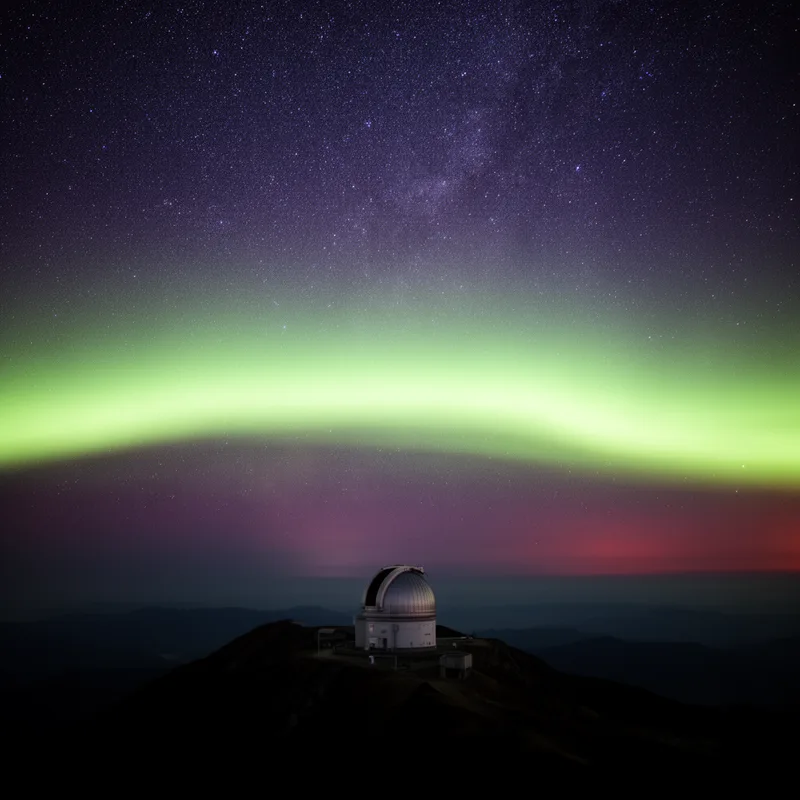
airglow
- noun
- /ˈɛrˌɡloʊ/
- Specialized
- Persistent train: the glow in the path of a fireball that persists longer than a few tens of seconds and is caused by airglow-type chemistry.
- natural airglow
Examples
-
Many lamps were dead; the night airglow and the rain reflection contoured the silhouette of the withered cypress railings with copper ends.
Fiction book (2000) -
Moreover, there is a faint emission (called airglow) from atoms and ions high in the atmosphere that are excited by energetic particles trapped in the Earth's magnetic field.
Academic text (1990) -
The diagonal swath is the Milky Way; the wispy features around the edges are from natural airglow.
Academic text (2006) -
At the same time, physicist Joe Kristl and colleagues at Stewart Radiance Laboratory near Boston measured that the nighttime hydroxyl (OH) airglow became 30% brighter during the storm.
Academic text (2001) -
The luminescent glow is caused by the same type of chemistry that is responsible for the natural airglow emission of sodium, except that now the iron atoms in the meteor train catalyze the reaction of ambient ozone molecules and oxygen atoms in the train.
Academic text (2001) -
The faint greenish light in the night sky, known as airglow, can often be seen near the horizon.
-
Photographers love to capture the subtle beauty of airglow illuminating the night sky.
-
When observing the stars, we noticed the delicate shimmer of airglow enhancing the scenery.
Synonyms
A faint light in the night sky caused by chemical reactions in the upper atmosphere
How Bright


Surface Forms
Morphology
Etymology
Airglow is a simple combination of air ('the atmosphere') and glow ('soft light'), so it literally means a faint light in the air. That's why airglow describes the very weak natural light you sometimes see high in the night sky.