

air-raid shelter
 2
4.4
2
4.4

- noun
- /ˈɛrˌreɪd ˈʃɛltər/
- In the summer of 2005, staff members at an elementary school in north London discovered the entrance to an air-raid shelter under a playing field.
Examples
-
In the run-up to WWII, British officials were frightened by the prospect of those very same tactics, so the U.K. passed legislation to begin digging air-raid shelters.
Academic text (2011) -
After hearing the sirens, we quickly ran to the air-raid shelter for protection from the impending attack.
-
Okay, Richard, on your way to the air raid shelter.
-
So now it's an air-raid shelter, is it?
-
Pete's air raid shelter in his back yard.
-
So, if you could run to that lamppost, you knew that you could make it to the air raid shelter before the bombs started dropping.
-
The cistern also acted as an air raid shelter for about 160 people during World War II.
Academic text (2009) -
And what happened was that during the Blitz, the bombing, we went down to the cellar, which was supposed to be the air raid shelter, and spent the night there.
-
Months in air-raid shelters crammed in with 5,000 other people.
-
During the war, many families took refuge in the air-raid shelter to stay safe from bombings.
Synonyms
 253
1.0
253
1.0
A place that protects people from danger or bad weather
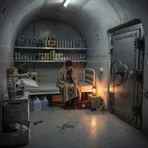 28
3.4
28
3.4
A strong place often underground where people stay to be safe from bombs
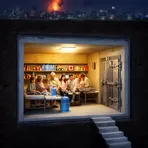
A strong underground shelter where people stay to protect from bombs

A very strong room or building that protects people from bomb explosions
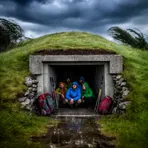
A man-made shelter that protects people from bad weather or attack
How Protective

Surface Forms
Morphology
air-raid + shelter
The meaning 'a shelter for protection during air raids' is directly and compositionally derived from 'air-raid' (an attack from the air) + 'shelter' (a place offering protection). This noun-compound pattern is common and cross-linguistically transparent, so a B1 learner who knows the constituent words would readily infer the MWE's meaning.
Etymology
Air-raid shelter comes from a simple wartime picture: a shelter where people hid from bombs falling from the air during a raid. So, the phrase now means 'a strong place to stay safe during bombing attacks'.