

adumbration


 1
9.9
1
9.9
- noun
- /ˌædʌmˈbreɪʃən/
- Formal
- A paragraph about his various professions defines him and transforms the story into an adumbration of Borges' writings.
Examples
-
Like a dark, drying sail, it stretches across the verdant lawn to the doorway of the tabernacle where, in a shifting adumbration of the crucifix, six watermen are talking quietly.
Academic text (1994) -
This circular movement is a rough adumbration of the drive, the purpose of which manifests itself in the aim rather than in the goal.
Academic text (1995) -
Like many of the Jews of Paul's day, Paul sometimes understood scriptural texts as adumbrations of later events.
Academic text (2000) -
But Catholic Christians claim that the symbol of the Trinity, however tentative, is the noblest adumbration yet evolved by man of his highest thought, and that it holds promise of yet unexhausted meanings to the pilgrim soul.
Academic text (2017) -
The teacher provided an adumbration of the upcoming project to help students prepare their ideas.
-
In the movie, the brief scene at the beginning serves as an adumbration of the characters' struggles later on.
-
His speech was an adumbration of the main themes of his upcoming book, giving the audience a taste of what to expect.
Synonyms
 229
1.5
229
1.5
A small indirect suggestion that helps you understand something
 180
2.4
180
2.4
A small amount of something you can just notice
 59
2.7
59
2.7
A short plan that shows the main points of something
 6
7.7
6
7.7
A small hint that something is true or will happen
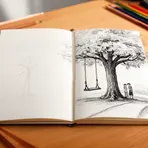
A faint early hint of an idea that appears later

An event or example that shows what will happen later
Antonyms


Compounds
How Explicit

Surface Forms
Morphology
Etymology
Adumbration comes from the Latin parts ad- ('to') and umbra ('shadow'), so it originally meant 'to cast a shadow'. That's why an adumbration is a faint outline or hint — like a shadowy sketch that shows a little of what will come.