

adrift
 7
4.4
7
4.4

- adjective
- /əˈdrɪft/
- My ship was found adrift.
- set adrift
Loading YouTube…
Watch on YouTubeWe saw boats adrift in the Andaman Sea looking for safe harbor where people could could disembark.
- We saw boats adrift in the Andaman Sea looking for safe harbor where people could could disembark.
- So he said he was adrift at sea and he said the US Coast Guard picked him up, right?
Examples
-
The Nathaniel Palmer was found adrift, the crew infected and dead.
-
Oh, the joy of seeing the glorious old canvases bobbing adrift on those waters, discolored and shredded.
Blog text (3) -
So he said he was adrift at sea and he said the US Coast Guard picked him up, right?
-
But one of the ships did pick up a man adrift at sea.
-
I'm currently out of fuel and adrift, do you copy?
-
Immediately, the raft nudged away from the dock and we were adrift.
Fiction book (1999) -
We saw boats adrift in the Andaman Sea looking for safe harbor where people could could disembark.
-
On its return voyage, the Indianapolis was torpedoed and its crew set adrift on life rafts.
Fiction book (1998) -
SHIP'S ENGINEER OFFICER, ADRIFT 17 DAYS, LYING HERE FOR 4.
-
The small boat was left adrift in the harbor after the storm passed.
Synonyms
 7
4.2
7
4.2
Drifting without a clear direction, often about people or plans
 3
7.0
3
7.0
Not held in place and often feels unstable or uncertain

Floating on water without sinking
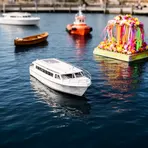
A craft or object that floats on water like a boat

Floating at sea and away from land
Antonyms

How Adrift

Surface Forms
Morphology
adrift = drift (semi-transparent) = a + drift
The prefix 'a-' suggests 'in a state of', but the specific meaning of floating freely is not fully transparent.
Etymology
Adrift comes from the old parts a- (meaning 'on' or 'in') and drift (meaning 'to be carried along'). So if something is adrift it is 'carried on the water', which is why it means floating freely and not attached to anything.