

adhesive bandage
 1
2.2
1
2.2

- noun
- /ædˈhiːsɪv ˈbændɪdʒ/
- Sam applied an adhesive bandage to her hand after cutting it while cooking.
Examples
-
Make sure to keep some adhesive bandages in your first aid kit for any minor injuries.
-
We got antiseptic and adhesive bandages!
-
She capped her tube and put a festive adhesive bandage across the heel.
Fiction book (1998) -
Gorvitz made the grip from ceramic, and they baked it in the oven; then Saint-Just covered it with layers of adhesive bandages.
Fiction book (1991) -
The Mistress used the moments my eyes were upon it to whisk a cushion onto the floor in front of me and a small brass bowl containing adhesive bandages and a wisp of cotton.
Fiction book (2000) -
The nurse recommended using an adhesive bandage to cover the small scrape on my knee.
Synonyms
 126
1.0
126
1.0
A piece of soft material that covers and protects a wound
 16
1.8
16
1.8
A small sticky bandage used to cover cuts or blisters
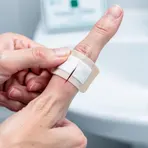 5
1.0
5
1.0
A small sticky piece of cloth or plastic used to cover a cut
 3
2.8
3
2.8
A piece of clean cloth placed over a wound to protect it
 1
3.5
1
3.5
A small sticky bandage that covers and protects a cut
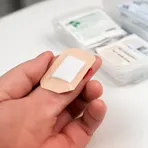
A small sticky bandage that covers and protects minor cuts
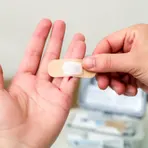
A small sticky bandage put on a small cut to protect it

A clean piece of cloth or pad placed over a wound to protect it

A clean pad of cotton or gauze that covers a wound after surgery to protect it
How Sticky
277
1.0
 1
2.2
1
2.2
Surface Forms
Morphology
The noun phrase is directly compositional: 'adhesive' means sticky and 'bandage' means material used to protect a wound, so 'adhesive bandage' clearly denotes a wound-covering with a sticky surface. This straightforward noun-noun composition is cross-linguistically common and follows regular English compounding, so a B1 learner who knows both words will readily infer the meaning.
Etymology
The noun adhesive bandage comes from the idea of a small bandage with a sticky side—adhesive means 'sticky' and a bandage is the cloth that covers a cut. That's why it means 'a small sticky strip used to cover minor wounds'.