
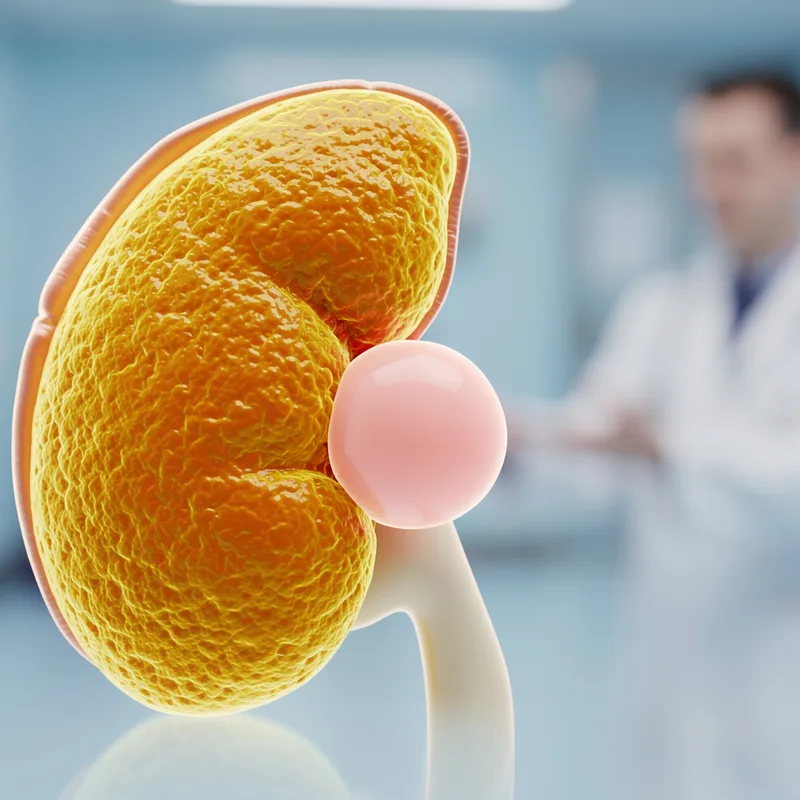
adenoma
 2
7.7
2
7.7

- noun
- /ˌædəˈnoʊmə/
- Specialized
- The doctor explained that the adenoma found in the patient's thyroid was benign and did not require surgery.
- pituitary adenoma
- pleomorphic adenoma
- parathyroid adenoma
Examples
-
Hyperparathyroidism is frequently caused by the development of a parathyroid adenoma and less often by hyperplasia or carcinoma.
Academic text (2005) -
The size of a parathyroid adenoma is correlated with the level of parathyroid hormone in the blood.
Academic text (2005) -
I know a benign adenoma when I see one.
-
This is a benign adenoma.
-
Could be a benign adenoma.
-
The pathologic diagnosis of pleomorphic adenoma was originally made 8 years ago.
Academic text (2005) -
Detailed information on all cases of CRC and adenomas is stored in a central database.
Academic text (1996) -
One other patient whose cytology was definitive for a pleomorphic adenoma was recommended for surgery, but the patient refused.
Academic text (1999) -
At present, some secreting pituitary adenomas are accessible to medical therapy.
Academic text (2007) -
Patients with extracapsular rupture of a parathyroid adenoma may present with diverse symptomatology.
Academic text (2006)
Synonyms
 3
3.4
3
3.4
A growth in the body that is not cancer and does not spread to other parts

A non-cancerous growth that forms fluid-filled sacs in gland tissue

A small growth of gland tissue in the inner lining of the colon or rectum that can turn into cancer
Antonyms

Surface Forms
Morphology
adenoma = aden + oma
Composed of Greek combining forms ('aden-' for gland and the medical suffix '-oma' for tumour) that are unlikely to be recognizable to an average B1 learner, so the meaning is not derivable from familiar English base words.
Etymology
The word adenoma comes from Greek parts: aden- meaning 'gland' and -oma meaning 'swelling' or 'tumor'. So an adenoma is a 'gland' swelling, a growth from gland tissue that is usually not cancerous.