
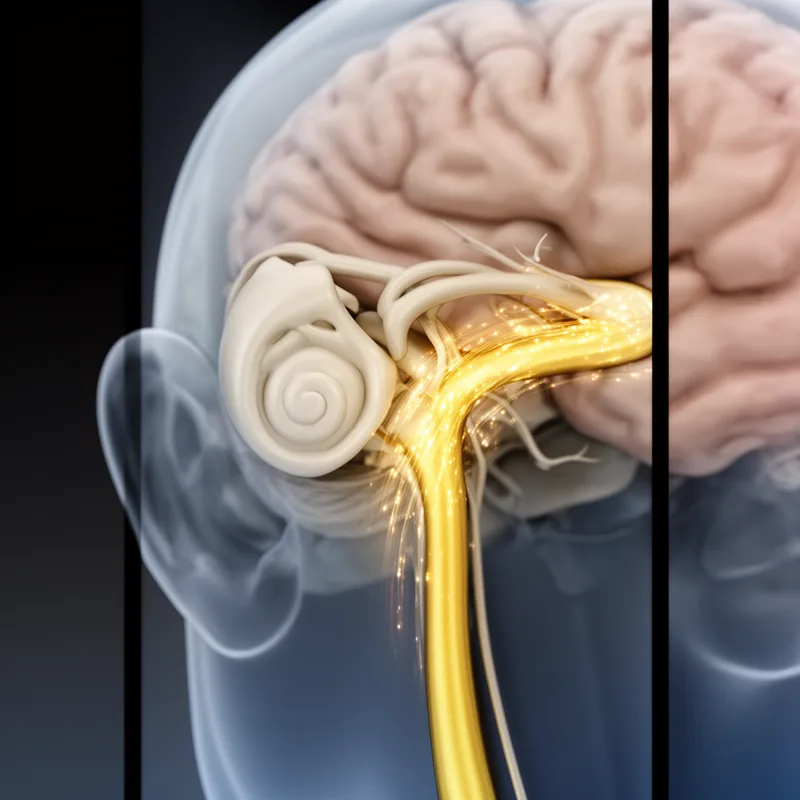
acoustic nerve
- noun
- /əˈkuːstɪk nɜrv/
- Specialized
- The doctor explained that the acoustic nerve transmits sound signals to the brain, enabling us to hear.
Examples
-
Damage to the acoustic nerve can lead to hearing loss and balance issues due to its vital role in the inner ear.
-
Electrophysiological tests can measure the function of the acoustic nerve to assess auditory processing.
-
The acoustic nerve is the most frequent site involved.
Academic text (2007) -
The ear is an uncommon site, although involvement of the acoustic nerve manifesting as sensorineural deafness has been documented.
Academic text (2003) -
Complete separation of the facial and acoustic nerves is apparent, and a discrete nervus intermedius develops.
Academic text (2003) -
The nervus intermedius, which is smaller than the motor root of the facial nerve, passes into the brainstem between the acoustic nerve and the facial nerve motor root.
Academic text (2003)
Synonyms

 1
4.5
1
4.5

A nerve that carries sound and balance signals from the inner ear to the brain

A nerve in the inner ear that sends sound and balance signals to the brain

The nerve that carries sound and balance signals from the inner ear to the brain

A nerve that carries sound and balance messages from the ear to the brain
Surface Forms
Morphology
The meaning 'the nerve that transmits sound' is directly derivable from combining 'acoustic' (relating to sound or hearing) with 'nerve' (a bundle that transmits impulses). This is a regular noun–noun compositional pattern, common cross-linguistically (e.g. Spanish 'nervio acústico'), so a B1 learner who knows both constituents would very likely infer the meaning.
Etymology
Acoustic nerve comes from a Greek word for 'hearing' and the word nerve. So it is the nerve that carries 'sound' and balance signals to the brain.