

acephalous
- adjective
- /əˈsɛfələs/
- Specialized
- The project team operated as an acephalous group, where everyone contributed equally without a formal hierarchy.
- acephalous organization
- acephalous society
Examples
-
The acephalous site of Tepetlaoztoc presented such a distinctive community form that it was identified as an area of tenant farmer or mayeque settlement by William Sanders, Jeffrey Parsons, and Robert Santley.
Academic text (1997) -
The global social justice movement shows a dispersed, decentralized, and acephalous organization that can rapidly shift and re-form at multiple scales.
Academic text (2008) -
Consider, for example, such terms of art as "acephalous community" and "cultural reproduction."
Academic text (1999) -
Instead, his authoritarian conspiracy is a decentralized, distributed, acephalous network.
Blog text (26) -
However, the development of incipient political centralization from acephalous social organization involves something more than the control of prestige goods.
Academic text (1998) -
GUMs may be acephalous or polycephalous, dispersed or concentrated.
Academic text (2008) -
Through their organized structure and this constant reshifting, Poro maintains the acephalous nature of Senufo society.
Academic text (1993) -
It is almost impossible to conceptualize the fluid and often acephalous organization of campesino mobilizations.
Academic text (2008) -
British colonial authorities, for example, felt threatened by acephalous and polycephalous movements like the Rastafari because they could not be extinguished as easily as centralized ones.
Academic text (2008) -
In some cultures, decision-making occurs in an acephalous way, with no single leader taking charge.
Synonyms
 25
4.0
25
4.0

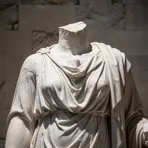
A person or object with no head, for example a statue
Antonyms

Surface Forms
Morphology
acephalous = cephalous (opaque) = a + cephal + ous
The combining form 'cephal' and the adjective 'cephalous' are specialized/learned scientific forms not familiar to average B1 learners, so adding the privative 'a-' does not yield a clearly derivable meaning for most learners.
Etymology
Acephalous comes from Greek parts a- meaning 'without' and kephalē meaning 'head', just like the word cephalopod, used for squid and octopus, where 'cephal' means 'head'. So acephalous literally means 'without a head', which is why we use it for animals, fossils, or groups that have no clear head or leader.