
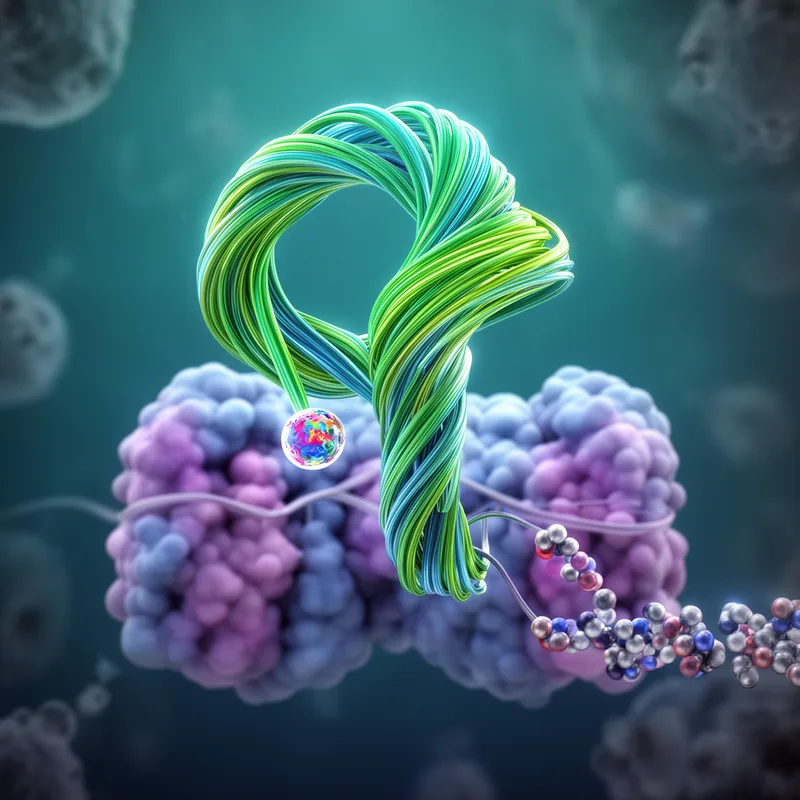
acceptor RNA
- noun
- /əˈsɛptər ˈɑːrnə/
- Specialized
- The acceptor RNA attaches the appropriate amino acid to the growing protein chain during synthesis.
Examples
-
The acceptor RNA helps ensure that each amino acid is added in the correct order during protein synthesis.
-
Scientists studied how acceptor RNA interacts with enzymes in the ribosome.
-
A mutation in acceptor RNA can disrupt the formation of functional proteins.
-
The acceptor RNA plays a crucial role in protein synthesis.
-
Without acceptor RNA, the translation process would fail.
-
During translation, the acceptor RNA ensures that each amino acid is added correctly according to the genetic code.
-
In the ribosome, the acceptor RNA plays a vital role in assembling proteins from amino acids.
Synonyms


 1
4.2
1
4.2
A small molecule in a cell that carries amino acids to ribosomes to make proteins

A small molecule that carries the building blocks of proteins to the protein-making part of a cell

A small RNA that carries amino acids to where proteins are made
Surface Forms
Morphology
The phrase is transparently compositional in form—'acceptor' (one that receives) + 'RNA' (a nucleic acid)—so a learner who knows both words can infer it is an RNA that receives or accepts something. However, the specific biochemical role (that it is the tRNA that accepts amino acids during protein synthesis) is domain-specific and not fully predictable from the constituents alone, so full understanding requires prior biological knowledge.
Etymology
Acceptor RNA is a name for a kind of RNA that helps build proteins; the word acceptor shows its job because one end 'accepts' the right 'building block' called an amino acid. Think of it as a tiny carrier with a pocket that takes the block to the protein-making machine, which is why the term means the RNA that accepts and brings amino acids to build proteins.